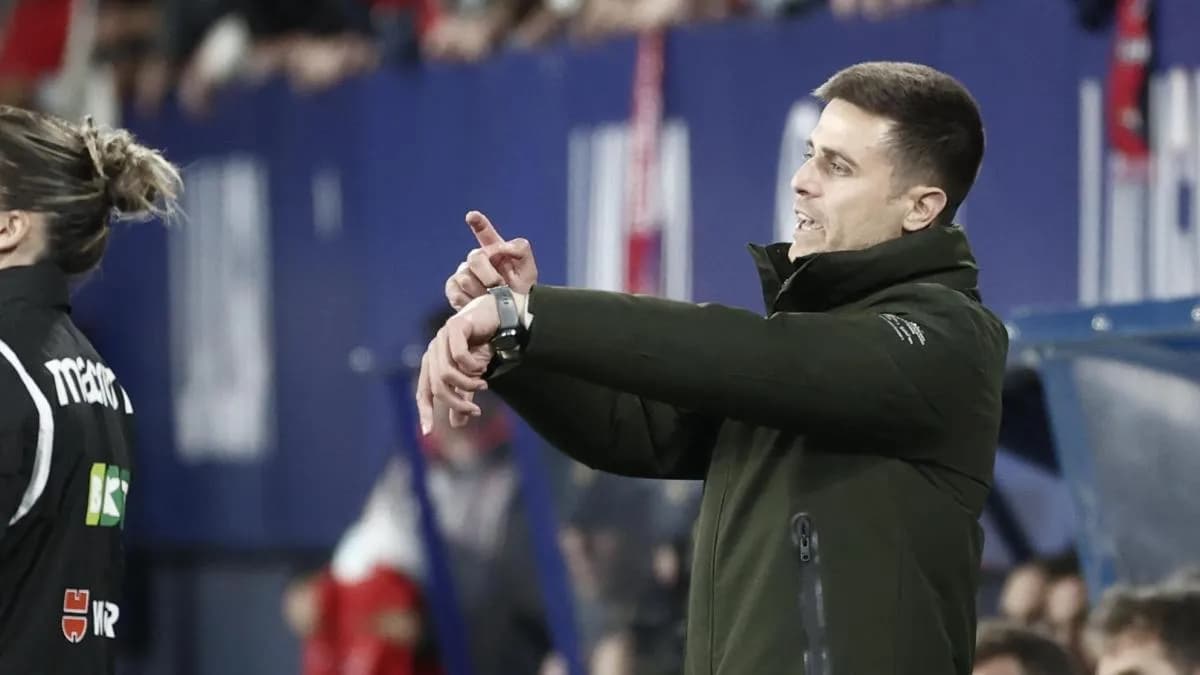
Alessio Lisci denounces Pubill's sending off and prepares the battle for survival in La Liga
Osasuna coach Alessio Lisci strongly criticizes Pubill's sending off against Atlético and is already looking ahead to the crucial match against Espanyol. He denounces an "unacceptable" added time that affected the result.
A contested sending off at the heart of Osasuna's tensions
Alessio Lisci, Osasuna's coach, did not mince his words following his team's home defeat against Atlético de Madrid, a setback that complicates the fight for survival. In a press conference, he described his player Pubill's sending off as "very clear," expressing deep frustration at this refereeing decision which he considers unjustifiable. "The red card for Pubill is very clear and the added time is unacceptable," he declared, also highlighting his incomprehension regarding the management of added time which, according to him, was unfair.
This sanction undoubtedly impacted Osasuna's momentum at a crucial moment in the season, where every point is precious to ensure survival in La Liga. Lisci's firm reaction reflects the importance of this decision on his team's morale and strategy.
A major challenge against Espanyol to secure permanence
Already under pressure after this defeat, Lisci announced a real "battle" ahead during the reception of Espanyol this Sunday. This home match promises to be a key appointment for Osasuna, who must imperatively gather points to avoid compromising their chances of survival. The context is all the more tense as the Navarrese side has not yet secured its position in the top flight, making every match decisive.
The confrontation against Espanyol will also be a test of collective resilience for a team marked by the previous disciplinary event and the pressure of a delicate end of season. The stakes go beyond the simple sporting result, revealing a mental and tactical battle to manage for Lisci and his players.
Pubill's early exit inevitably alters Osasuna's tactical balance. Playing with one less player against a caliber opponent like Atlético de Madrid complicates match management and restricts offensive options. The probable suspension of the player for upcoming matches further weakens an already pressured team.
This situation forces Lisci to rethink his schemes and mobilize his resources as best as possible to maximize the impact of his remaining players. It also highlights the importance of discipline and concentration in the decisive phases of the season, especially in a survival fight where every detail counts.
The role of refereeing decisions in La Liga dynamics
Lisci's criticisms highlight a recurring issue in professional football: the impact of refereeing decisions on the course of matches, especially in contexts where the slightest error can be costly. The perception of injustice, such as the one he mentions regarding added time, fuels debates on the consistency and rigor of referees in the competition.
This situation recalls the growing importance of technological devices like VAR, intended to bring more transparency. Yet, the feelings of coaches and players sometimes remain marked by frustrations when interpretative margins persist.
Concrete prospects for Osasuna and La Liga
With a decisive match against Espanyol imminent, Osasuna must imperatively capitalize on its home ground to reverse the trend. Survival in La Liga will depend on Lisci's ability to mobilize his troops despite recent setbacks, notably Pubill's suspension. The context underlines the ruthless nature of the competition and the need to manage contingencies with composure and strategy.
This upcoming battle also illustrates the constant pressure faced by clubs fighting for survival, where refereeing decisions and time management can tip a season. Osasuna will therefore have to combine discipline, tactics, and resilience to achieve its goal.
A story rooted in resilience and struggle
Osasuna, a flagship club from Pamplona, is known for its combative identity and ability to fight against all odds. Historically, the club has often been an outsider in the Spanish top flight, with seasons marked by fierce survival battles. This tradition of tenacity is deeply ingrained in the mentality of the club and its supporters, who see every match as a battle to win. The current context fits into this continuity, where Osasuna's fighting spirit is severely tested against sporting challenges and contested refereeing decisions.
This season is no exception, and the difficulties encountered remind us that La Liga remains a demanding championship, where experience and solidarity can make the difference. The tactical and psychological challenge represented by the survival fight is thus another chapter in the history of a club that has always known how to draw on its resources to survive.
Tactical issues and necessary adaptations
Alessio Lisci's management of the team in adversity reveals the importance of tactical flexibility in a fight as tight as that for survival. The loss of Pubill, a key player, requires immediate adjustments in the setup. Lisci will probably have to rethink his system by placing more emphasis on defensive solidity while maintaining offensive options to surprise Espanyol. The ability to alternate between low block phases and high pressing could be decisive.
Moreover, managing players' physical and mental resources will be crucial in this end of season. Accumulated fatigue and constant pressure weigh on the squad. Lisci must therefore find the balance between intensity and energy conservation, with particular attention to discipline, to avoid further suspensions or injuries. These tactical and human choices will be essential to approach upcoming deadlines with serenity.
Impact on the standings and medium-term prospects
The defeat against Atlético de Madrid and Pubill's sending off have direct repercussions on Osasuna's position in the standings, increasing the threat of relegation. Every point lost in this critical phase reduces maneuvering margins, which adds extra pressure on upcoming matches, especially the one against Espanyol. The need to take points at home becomes paramount to avoid sliding into dangerous zones.
In the medium term, managing this difficult period could affect the club's stability. A loss of collective confidence or a series of poor results can have heavy consequences, both sportingly and financially. That is why Lisci's ability to maintain a fighting spirit and team cohesion will be a determining factor to ensure Osasuna's sustainability in La Liga. The club must also consider longer-term solutions to strengthen its squad and avoid reliving such tension.
In summary
Alessio Lisci's reaction is symptomatic of the tension surrounding the final phases of La Liga. His clear and unequivocal criticism of Pubill's sending off and the added time shows justified frustration in a context where every point is crucial. Osasuna's situation also illustrates the challenges coaches face to keep their team afloat amid unforeseen events.
Beyond the simple controversy, this case illustrates the need for reinforced refereeing consistency and more precise management of added time, to prevent subjective decisions from excessively weighing on clubs' destinies. For Osasuna, the next match against Espanyol will be a test of character, and Lisci's ability to keep his group united will be decisive.