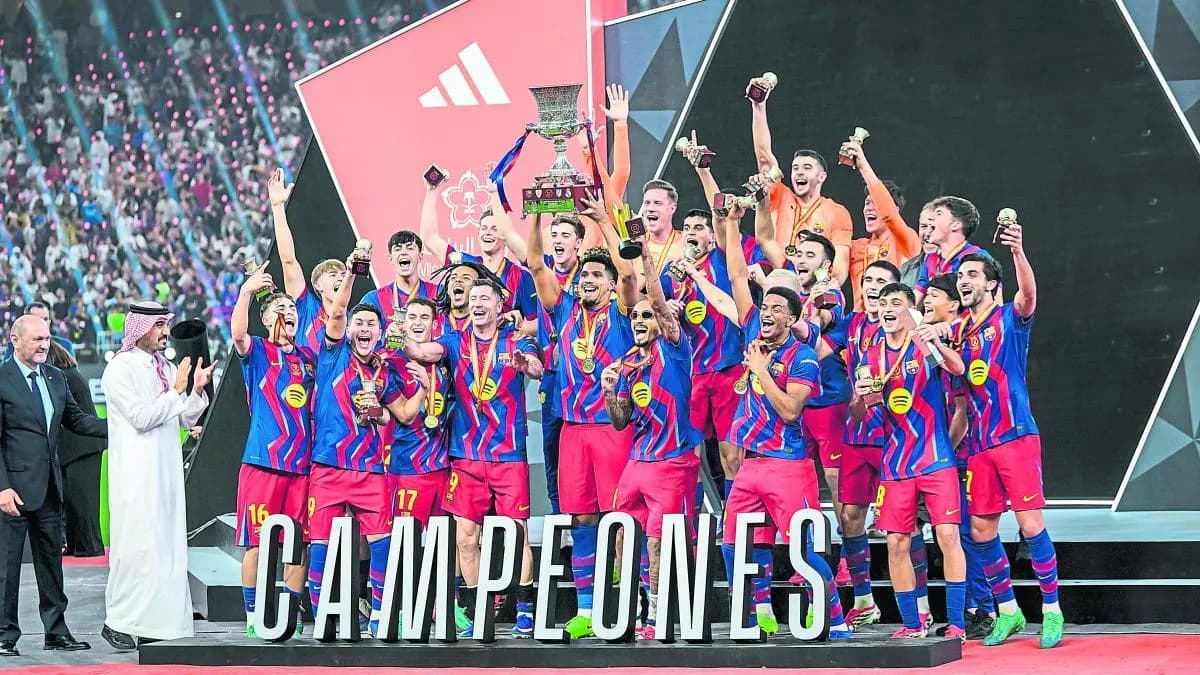
Barcelona wins another Supercopa de España against Real Madrid under Hansi Flick
FC Barcelona won its sixteenth Supercopa de España, the second consecutive under the leadership of Hansi Flick, by beating Real Madrid again in the final. This victory comes in a context where the Blaugrana show a much more stable dynamic than their Madrid rival, who is in full disintegration under Xabi Alonso.
Another Supercopa for Barcelona, confirmation under Flick
FC Barcelona has added a new line to its record by winning its sixteenth Supercopa de España, and this for the second consecutive time with Hansi Flick at the helm. The Catalan club once again imposed its superiority over Real Madrid in the final, thus confirming its recent dominance over its historic rival. According to Mundo Deportivo, this victory illustrates a clearly upward dynamic for Barça, sharply contrasting with the situation of Real Madrid.
While the Blaugrana had only one recent defeat, conceded at Stamford Bridge against Chelsea (3-0), their Madrid opponent, led by former player Xabi Alonso, is experiencing a period of crisis and internal disintegration. This context clearly played in favor of Barcelona, who capitalized on the stability and coherence of its squad.
Opposite sporting contexts: Blaugrana stability vs. Madrid turbulence
The trajectory of the two teams leading to this Supercopa reveals the current stakes of Spanish football. FC Barcelona, under Flick's guidance, shows a solid record, marked by only one significant defeat after a La Liga Clasico, a sign of a well-organized team capable of high-level performances.
In contrast, Real Madrid is going through a phase of disintegration, with visible tensions within the squad and a sporting management seeking solutions. The choice of Xabi Alonso as coach has not yet allowed the Madrid club to regain tactical coherence and competitive stability, which was felt in their journey to the final.
This situation highlights the importance of management and sporting strategy in a club's success, with Barcelona seeming to have found a promising balance thanks to Flick, while Madrid struggles to reinvent itself.
Implications for La Liga and the Barcelona-Real rivalry
This new Supercopa victory strengthens FC Barcelona's position as a major and stable player in La Liga, capable of effectively competing with Real Madrid despite recent financial and sporting challenges. Success under Flick could also attract talents and solidify the team's core for upcoming competitions.
For Real Madrid, this defeat is a major wake-up call. The mentioned disintegration suggests the need for deep reforms, both in sporting and managerial terms, for the club to regain its former glory and once again contend for national and European titles.
Analysis: a turning point for the two Spanish giants
From a tactical point of view, Flick's management has allowed Barcelona to fully exploit its strengths, notably in defense and collective continuity. This consistency is a key factor in winning titles and managing major events.
On the Madrid side, the lack of stability, combined with a delicate transition under Xabi Alonso, raises questions about the club's ability to reinvent itself amid increased competition. This Supercopa could be seen as a tipping point in the historic rivalry between these two institutions.
According to available data, Barcelona thus confirms its place as leader on the Spanish scene, while Real Madrid must urgently correct course to remain competitive in this increasingly contested La Liga.
A rich historical context for the Supercopa de España
The Supercopa de España, established in 1982, has become over the decades an emblematic competition of Spanish football, often seen as a prelude to the major battles of La Liga and the Copa del Rey. Barcelona and Real Madrid, as two of the most decorated and popular clubs in Spain, have deeply marked this competition, engaging in epic clashes that fuel their century-old rivalry.
The fact that FC Barcelona wins today its sixteenth Supercopa not only reflects its longevity at the highest level but also its ability to handle the pressure of big occasions. This competition, although sometimes relegated to the background behind continental stakes, represents a true barometer of teams' form and preparation at the start of the season.
Historically, successes in the Supercopa have often formed the foundation of successful campaigns in the league or Champions League. Thus, the current victory under Flick fits into a glorious tradition, reinforcing the Catalan club's aura and prestige on the national stage.
On the tactical level, Hansi Flick has instilled rigor and solid organization in his team, emphasizing a compact defense and smooth transition between lines. This approach has allowed the Blaugrana to display remarkable consistency, especially against high-level opponents like Real Madrid.
The collective mastery observed during this Supercopa highlights Flick's ability to exploit individual qualities while prioritizing a strong group unity. In comparison, Real Madrid, in full reconstruction under Xabi Alonso, struggles to stabilize its playing system, resulting in tactical disorganization and a lack of offensive fluidity.
This difference in philosophy and tactical execution proved decisive in the tournament's course. For Barcelona, the victory is also the result of meticulous preparation and constant adaptation, essential factors to dominate a rival as prestigious as Real Madrid.
Perspectives: what are the stakes for the rest of the season and beyond?
The triumph in the Supercopa offers FC Barcelona a positive momentum to approach upcoming challenges, notably in La Liga and on the European stage. This victory consolidates collective confidence and can serve as a springboard to attract new talents, convinced by the stability and ambition of the sporting project led by Flick.
For Real Madrid, the defeat underlines the urgency of a strategic overhaul. The management will likely have to reassess its choices, both in terms of group management and tactical orientation, to restore the club's efficiency and competitiveness. The pressure is high, as supporters' and leaders' expectations remain elevated, and the gap accumulated against a galvanized Barça can quickly widen.
Beyond the direct rivalry, these developments impact the entire La Liga, which benefits from a resurgence of competitiveness and a new balance between the forces at play. The battle for the title promises to be more open, with a FC Barcelona driven by an upward dynamic and a Real Madrid forced to reinvent itself to stay in the race.
In summary
FC Barcelona's victory in the Supercopa de España, under the direction of Hansi Flick, marks an important milestone in the Catalan club's season and in the historic rivalry with Real Madrid. While Barcelona confirms its stability and ability to perform in big occasions, Real Madrid faces major challenges both on the sporting and managerial levels. This confrontation crystallizes the current stakes of Spanish football, where management, tactics, and collective coherence are determining factors to dominate the national scene. The future of these two giants of Spanish football will depend on their ability to adapt and evolve in an increasingly competitive and demanding championship.