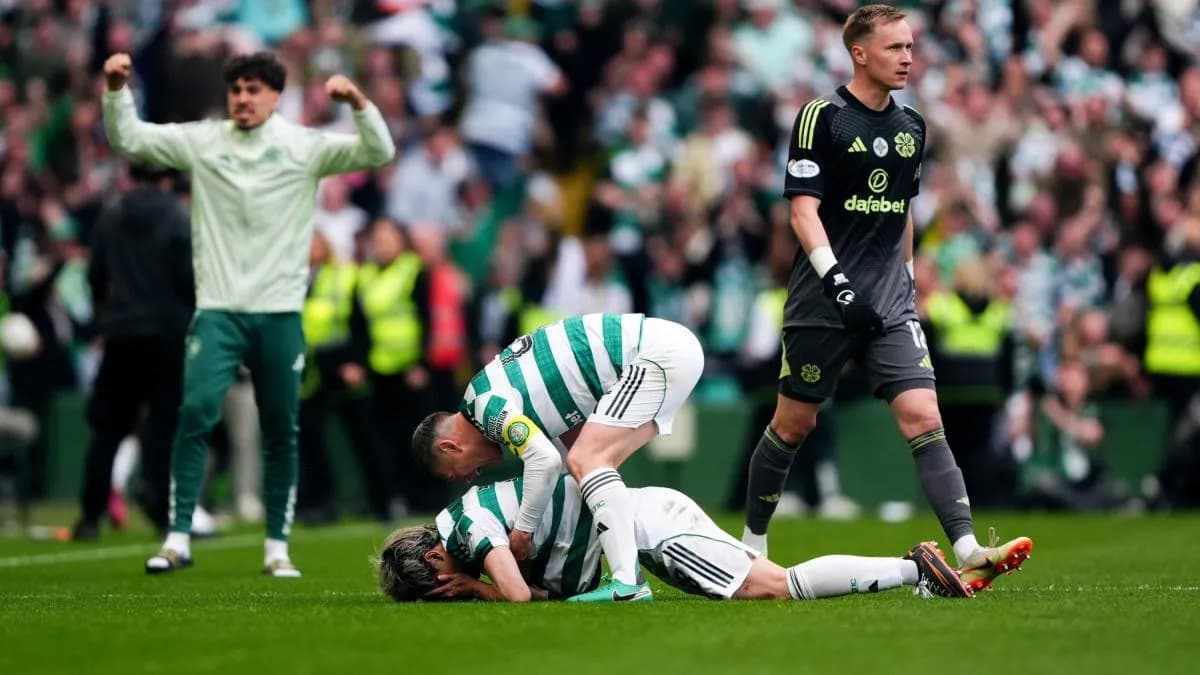
Celtic won their 57th Scottish championship title by securing a crucial victory against Hearts thanks to a VAR-validated goal in the 87th minute. This end of the season reignites the historic rivalry with Rangers and maintains the dominance of the Glasgow giants.
A late climax for an expected triumph
Since 1985, the Scottish League has been the domain of Celtic or Rangers, and this season's scenario was no exception. Celtic ended Hearts' dream, who had long believed they could break this hegemony, by winning thanks to a decisive goal scored in the 87th minute by Maeda, validated after a VAR intervention. This goal allowed the Bhoys to claim their 57th national title, thus consolidating their place at the top of Scottish football.
The Hearts, nicknamed the 'Jambos', held their own until the last ten minutes and came very close to winning a title they have not won since 1960. Their performance nevertheless breathed new life into the competition, even if history dictated that the trophy remain in the hands of the two Glasgow giants.
The duel between Celtic and Hearts perfectly illustrates the duality of the Scottish championship, where the fight for the title is traditionally dominated by Celtic and Rangers. This season, Hearts managed to rise to the level of the league's heavyweights, demonstrating remarkable progress that kept supporters and observers on edge.
The fact that Celtic had to wait for a VAR intervention to validate Maeda's goal highlights the tension and uncertainty that marked this end of the season. This refereeing decision not only sealed the fate of the championship but also highlighted the growing importance of technology in sports officiating.
The crucial role of VAR in the final decision
The VAR intervention in the 87th minute was decisive in the outcome of the crucial match. This system, introduced to strengthen sporting justice, confirmed the validity of Maeda's goal, which could have been contested on the field. This validation dashed Hearts' hopes and secured victory for Celtic in a high-pressure context.
Beyond the simple decision, this situation illustrates how technology is transforming the management of sports competitions, reducing human errors and bringing more transparency to results. The adoption of VAR in European leagues, including the Scottish League, is now a key element in organizing high-intensity matches.
Confirmation of a historic dominance
With this new triumph, Celtic adds a 57th title to its record, confirming its position as the undisputed leader in Scottish football. Since 1985, the championship has only known two winners, Celtic and Rangers, and this season did not reverse the trend despite Hearts' resurgence.
This record testifies to the sporting and economic power of the Glasgow clubs, capable of maintaining a high level of performance over the long term. Hearts will have to wait longer before breaking this hegemony, but their recent progress suggests a more competitive future for the Scottish League.
Outlook for the Scottish championship
Celtic's success and Hearts' rise could energize the championship by strengthening the rivalry and increasing supporters' interest. This season showed that the historic dominance can be challenged, even if the final victory went to the favorites.
The Scottish League could thus benefit from renewed appeal, with clubs able to challenge the giants and offer more balanced confrontations. This context is conducive to strategic evolution of teams, notably in recruitment and sports management, with hopes of eventually winning the title.
Our analysis
Celtic's victory after a tight match decided by a VAR decision illustrates the growing complexity of modern football, where technology plays a decisive role. The confirmation of the supremacy of the Glasgow clubs should not overshadow Hearts' progress, who pose a serious threat to the traditional balance of the League.
It will be interesting to see how other clubs adapt to this dynamic, especially in terms of sports strategy and investments. The Scottish championship, although historically dominated by two heavyweights, could see new competition emerge in the coming seasons.
A rich historical context for Celtic and Hearts
Celtic, founded in 1887, is one of the most emblematic clubs in European football, with a history marked by national and international successes, notably their victory in the European Cup in 1967. The club has built a strong identity, symbolized by its green and white colors and its attachment to Glasgow's Irish community. Rangers, their eternal rival, together with Celtic form the famous "Old Firm," a rivalry that goes beyond sport to encompass deep cultural and social dimensions.
On their side, Hearts of Midlothian, founded in 1874, are one of Scotland's oldest clubs. Based in Edinburgh, they represent the capital and cultivate a solid tradition, although less decorated than that of the Glasgow clubs. Their last championship title dates back to 1960, making their run this season all the more impressive. Their return to the forefront after several decades reflects deep work and renewed ambition, which could eventually shake up the established hierarchy.
Tactical stakes and strategies deployed
On the tactical level, this season was marked by an intense confrontation between two opposing philosophies. Celtic, under their coach's guidance, favored football based on possession, high pressing, and rapid exploitation of spaces, which proved effective over time. Their ability to keep the ball and impose a sustained pace often put opposing defenses under pressure.
Hearts, for their part, adopted a more pragmatic approach, focused on solid defensive organization and quick counter-attacks. This strategy allowed the 'Jambos' to hold their own against the league giants for much of the season, highlighting the quality of their squad and group cohesion. The decisive match, with a late goal validated by VAR, perfectly reflects this tight and balanced tactical battle.
Impact on the standings and future implications
Celtic's triumph not only confirms their supremacy but also ensures direct qualification for European competitions, enhancing their attractiveness in the transfer market and their financial position. For Hearts, despite this cruel defeat, the season is a major springboard. Their performance allows them to hope for a European spot through the standings or national cups, which would send a strong signal to the club and its supporters.
In the overall standings, this fierce battle has revived interest in the Scottish League, often criticized for its lack of suspense. The pressure exerted by Hearts could encourage historic clubs to intensify their efforts to maintain their hegemony, while other teams might draw inspiration from this season to strengthen their competitiveness. Such a context thus promises more contested seasons and a potentially more attractive championship both sportingly and in the media.
In summary
The 2026 Scottish League once again confirmed the historic dominance of the two Glasgow giants, with Celtic claiming their 57th title thanks to a late goal by Maeda validated by VAR. Hearts, after decades of waiting, showed an ambitious and combative face, flirting with a triumph that would have reshuffled the championship cards. This season illustrates both the power of established clubs and the emergence of a new dynamic, driven by teams determined to challenge the established order. Scottish football, nourished by a rich history and passionate rivalries, seems ready to experience more competitive and promising years ahead.