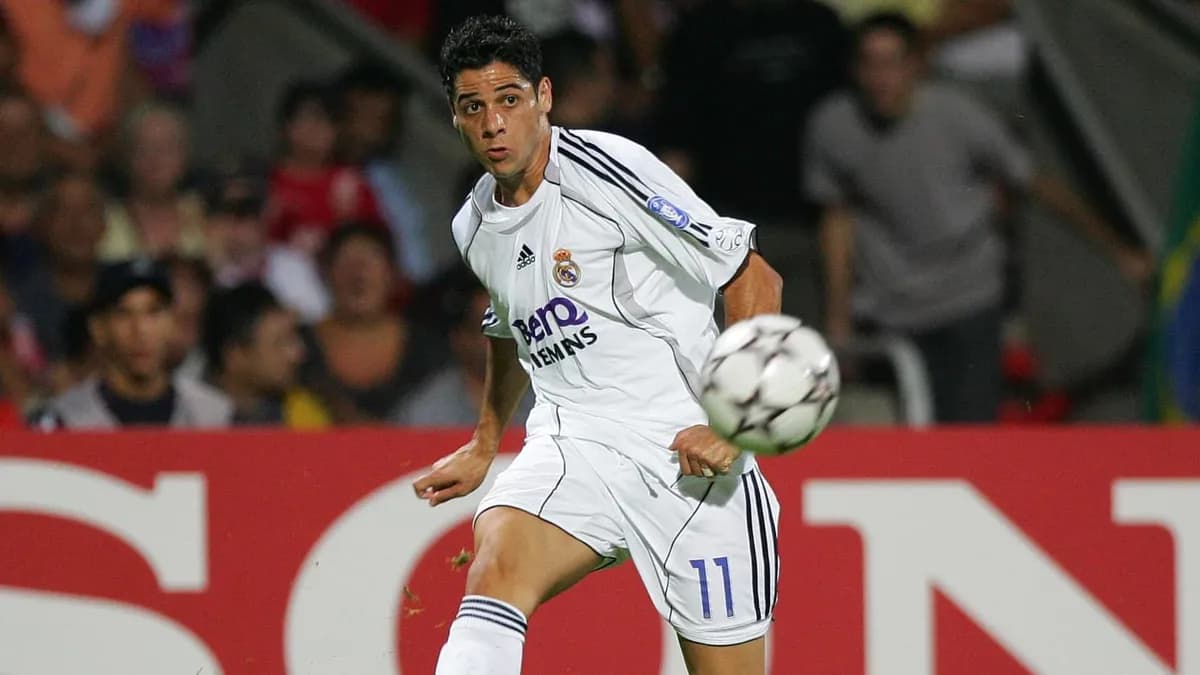
Cicinho: Revelations About His Struggle with Alcoholism After Real Madrid and AS Roma
Former Brazilian full-back Cicinho opens up about his alcohol addiction, mentioning a record of 70 beers and 15 caipirinhas in a single day. Thanks to his wife's support, he has been sober for 14 years and shares his story of hitting rock bottom.
A shocking confession about the addiction of a former top-level player
In an interview with Gazzetta dello Sport, Cicinho, former right-back who played for Real Madrid and AS Roma, openly recounted his long battle with alcoholism. Now 45 years old, the Brazilian revealed a particularly striking episode of his addiction: "My record? 70 beers and 15 caipirinhas in one day." This testimony sheds light on a little-known side of the life of a renowned footballer, whose career was not spared by excesses.
According to RMC Sport, Cicinho emphasizes that this dark period almost cost him his life and career. However, he confides that a decisive turning point came 14 years ago when he decided to quit alcohol completely. He credits his salvation to his wife, who supported him and helped him stay away from this destructive addiction. This testimony is all the more poignant as it illustrates the difficulties some athletes face in managing their private lives and mental health.
Cicinho reached his peak in the early 2000s, notably during his time at Real Madrid, an iconic club where pressure and media exposure are extreme. His transfer to AS Roma also made headlines, but it was especially the management of his off-field life that revealed weaknesses. Alcoholism, often taboo in the football world, is depicted here without filters, with impressive figures that testify to the scale of the problem.
Addictions can have a direct impact on sporting performance and a player's longevity. In Cicinho's case, this downward spiral likely interrupted a promising trajectory in major clubs. Ligue 1 and the Champions League, competitions in which he participated with his clubs, demand total commitment, incompatible with such excesses.
The Brazilian, who has not drunk for over a decade, has become an example of resilience. His testimony also highlights the importance of family support in the fight against addictions. His wife, by accompanying him through this process, played a crucial role in this rebirth.
A look at addiction in professional football
Cicinho's revelation comes at a time when the mental health of professional athletes is increasingly at the center of debates. Efforts to raise awareness and support players on these issues are multiplying, both within clubs and at federation levels. However, the stigma related to alcohol and other addictions remains strong, making any opening-up process difficult.
This rare and authentic testimony offers a human perspective behind the scenes of high-level football. It reminds us that behind the performances and spectacular transfers, players remain vulnerable to personal pitfalls. The media coverage of such stories can help better understand and prevent these situations.
A life lesson and an example for sport
With this story, Cicinho does not just confess his past; he also invites broader reflection on managing a sports career and off-field challenges. His sobriety for 14 years testifies to a strong will for renewal. This journey reinforces the idea that sporting success cannot be separated from personal balance, especially in demanding environments like Real Madrid, AS Roma, or Ligue 1.
His story joins other testimonies from former players confronted with addictions, helping to break the silence and encourage seeking help. This sincerity has an important educational impact, particularly for young talents entering the professional world with all its pressures.
In summary, Cicinho's story is a mix of warning and hope, where the fall gives way to rebuilding. He thus embodies a little-known but essential facet of football, beyond the fields and transfers, a human and social dimension that deserves greater attention.
The historical context of Real Madrid and AS Roma in the 2000s
The early 2000s were a pivotal period for Real Madrid, marked by the Galacticos era, with the arrival of world stars like Zidane, Figo, and Ronaldo. This context created an extremely competitive and media-heavy environment, where pressure on players, even less prominent ones like Cicinho, was enormous. The club aimed for European and national excellence, with constant demands that could exacerbate players' personal weaknesses.
Meanwhile, AS Roma experienced a dynamic period in Serie A, often fighting for European spots. The Italian club, passionate and driven by a strong local identity, imposed a tactically rigorous style of play, where each player had to meet strong physical and mental demands. For a footballer, playing in these two clubs represented a major challenge, both sportingly and psychologically.
Tactical challenges and impact on Cicinho's career
On the field, Cicinho was a right-back capable of contributing offensively while fulfilling his defensive duties, a valuable profile in his teams' tactical systems. His role required great endurance, the ability to repeat efforts, and constant concentration—conditions incompatible with severe addiction. Alcoholism could thus have impaired his performance, recovery, and consistency, crucial factors in demanding competitions like the Champions League.
Beyond his personal case, Cicinho's story illustrates how modern tactical demands impose iron discipline on players. Any failure, especially off the field, can have direct repercussions on club rankings and ambitions. In this perspective, managing private life becomes a determining factor for collective and individual success.