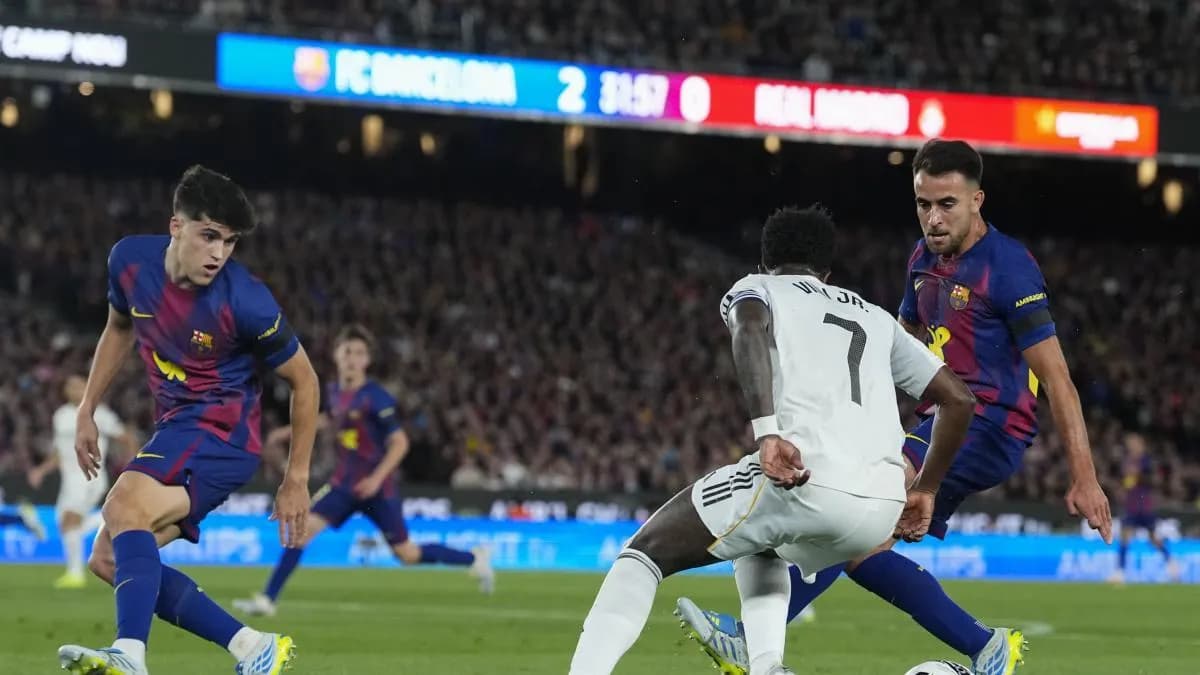
Eric Garcia: The Key Role of the Defender in Flick's Tactics to Win La Liga
Eric Garcia played a decisive role in Flick's strategy for conquering La Liga by adapting to an innovative tactical setup. His versatility and endurance helped Barça avoid major difficulties in the decisive match.
During the crucial final match to win La Liga, coach Flick had to work with a demanding tactical setup, relying on a quartet of untouchable players: Pedri, Gavi, Olmo, and Fermín. These key elements, due to their high performances, occupied the offensive and creative positions, thus limiting options for other players, notably Eric Garcia, whose place within the team was uncertain.
Faced with this situation, Flick showed ingenuity by repositioning Eric Garcia, usually a central defender, on the right flank of the defense. This decision preserved the effective structure put in place by the coach while maintaining the cohesion and dynamics of the group. Koundé, although available to play, was sidelined in favor of Eric Garcia, who had played the entire season, highlighting a desire for coherence and recognition of merit.
This reassignment of Eric Garcia to right-back was not trivial. It allowed addressing a specific threat, embodied by Alexander-Arnold, an opponent capable of destabilizing the defense through his mobility and offensive influence. Fermín, omnipresent on the field, also contributed to disrupting the opposing defense, creating a favorable environment for Barça's defensive solidity.
The central duo composed of Cubarsí and Gerard Martín showed exceptional performance, making Eric Garcia's integration in the center difficult. His tactical flexibility and game intelligence were put to use on the right side, where his presence strengthened defensive stability without compromising offensive phases. This adaptability was a key factor in avoiding an unfavorable scenario for the Catalan club.
Beyond mere physical presence, Eric Garcia provided a fine reading of the game, anticipating opponents' actions and securing critical areas of the pitch. His role as a tactical "joker" was thus decisive for Flick, fully justifying his starting position in this match of paramount importance.
A Meritocratic and Coherent Decision in Squad Management
Eric Garcia's season was marked by exemplary consistency, allowing him to claim a prime spot in the starting eleven. Flick, faithful to a meritocratic policy, wanted to reward this diligence by giving him a key role in the decisive match. Excluding him could have been perceived as unfair, especially since Koundé, although physically ready, had not benefited from the same continuity.
This fine management of human resources reflects a modern and balanced approach to sports management, where motivation and recognition of work are valued. Eric Garcia's ability to take on a different role without faltering also highlights the quality of the tactical work carried out internally by Barça's technical staff.
Implications for the Rest of the Season and Perspectives
According to available data and the Mundo Deportivo report, this tactical setup was a determining factor in FC Barcelona's conquest of La Liga. Highlighting Eric Garcia as a key element, in a less conventional role, opens interesting perspectives for the club's tactical flexibility in upcoming competitions.
Flick now has a reliable and versatile option capable of adapting to the demands of modern football. This versatility could also influence recruitment management and the implementation of strategic player rotation, essential in a busy schedule.
Historical Context of FC Barcelona in the Race for La Liga
FC Barcelona, an emblematic club of Spanish football, has always been a major player in the fight for the La Liga title. With a rich history of success, the Catalan club has often managed to bounce back from difficult periods thanks to its playing identity and the quality of its squad. This season, marked by tactical adjustments and promising youth, has reminded us of the importance of intelligent talent management to maintain competitiveness at the highest level.
The current championship context is all the more demanding as the competition has strengthened, requiring bold strategic choices. Barça's ability to rely on a quartet of untouchable players while adapting other elements like Eric Garcia demonstrates a desire to combine experience, youth, and tactical flexibility. This approach could mark a turning point in how the club approaches its national and European ambitions.
Tactical Stakes and Impact on the Final Standings
Flick's decision to reposition Eric Garcia had direct repercussions on the team's defensive and offensive dynamics. By effectively neutralizing opposing threats, notably by covering Alexander-Arnold, Barça was able to maintain rare solidity in crucial moments. This stability was a key element in winning the title, allowing the club to accumulate the necessary points to surpass its rivals in the standings.
On a tactical level, this flexibility allowed maintaining a balance between defensive rigor and offensive creativity. By keeping key players in their positions while intelligently integrating Eric Garcia, Flick maximized the available resources. This choice also preserved collective harmony, an essential element in a competition as tight as La Liga, where every point counts in the title race.
Perspectives for Rotation and Player Management
Eric Garcia's demonstrated versatility opens new perspectives in terms of rotation and squad management for FC Barcelona's technical staff. In a demanding schedule, marked by national and international competitions, the ability to adapt players to different roles can prove decisive in preserving the team's physical and mental freshness.
This approach could also influence future recruitment choices, favoring profiles capable of playing multiple positions. The emphasis on meritocracy and cohesion observed this season could thus become a pillar of the club's strategy, fostering a healthy and stimulating competitive environment for players. The success of this policy will nevertheless depend on the staff's ability to maintain a balance between tactical innovation and group stability.
Our Perspective
The decision to reposition Eric Garcia illustrates a growing trend in contemporary football, where player flexibility and adaptability become major assets. Flick was able to optimize his squad by valuing meritocracy and cohesion, thus avoiding unnecessary risks.
However, this strategy also relies on sound group management and rigorous physical preparation, without which the player could have suffered a drop in performance. Eric Garcia's example could inspire other coaches to fully exploit their players' potential outside their usual positions to maximize chances of success.
In Summary
The tactical management led by Flick during the decisive final phase of La Liga highlighted the importance of versatility and cohesion within FC Barcelona. By repositioning Eric Garcia on the right flank, the coach preserved a winning balance while rewarding consistency and merit. This strategy not only contributed to winning the title but also opens promising perspectives for future squad management and the ambitions of the Catalan club.