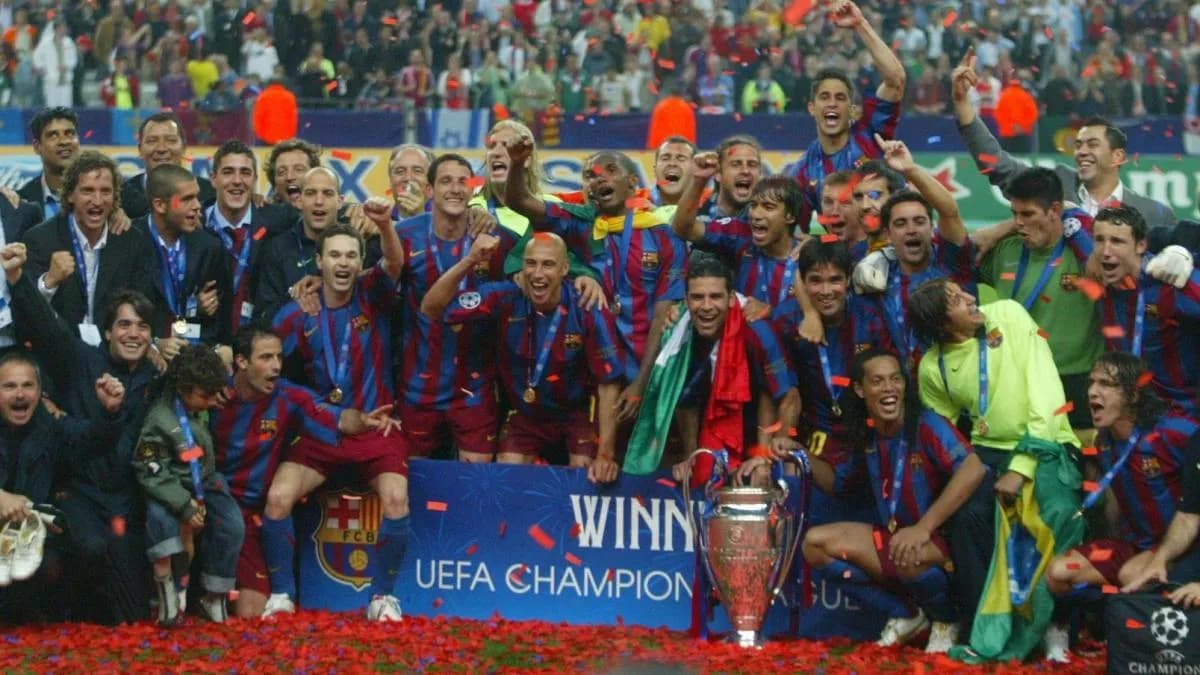
FC Barcelona: 20 Years Later, Analysis of the Impact of the Champions League Victory in Paris
Twenty years ago, FC Barcelona won its second Champions League in Paris, a major success that marked a turning point in the history of the Catalan club. A look back at this triumph, its immediate aftermath, and the challenges to reconnect with European victory.
A historic triumph in Paris that revived FC Barcelona
May 17 marks the twentieth anniversary of FC Barcelona's second Champions League victory, won during the 2005-06 season, fourteen years after the club's first European title in 1992. This final, played in Paris, symbolized a renewal for the Catalan club, which had established itself sustainably on the European stage. This victory laid the foundation for an era of more regular success, consolidating Barça's international stature.
According to Mundo Deportivo, this conquest was a pivotal moment because it allowed the club to reach a new level in the UEFA Champions League, marking the end of a long wait since the first victory. This 2006 success also served as a springboard for the club's golden generation, under the leadership of Frank Rijkaard and thanks to iconic players who combined talent and ambition.
After this Parisian triumph, FC Barcelona quickly renewed the feat with three other European titles in 2008-09, 2010-11, and 2014-15. These close successes confirmed the club's dominance on the European stage during this period. Barça capitalized on the momentum created in 2006, moving from a victory spaced by fourteen years to a series of exploits spaced by only a few years.
However, according to available data, the club has experienced a certain slowdown in its quest for a sixth Champions League, with the interval lengthening again. It will be necessary to wait at least until 2027 to consider a new title, a twelve-year gap since the last European victory, marking a new cycle of waiting for the club.
The tactical and sporting challenge behind the longevity of success cycles
This look back allows us to appreciate the complexity of maintaining a competitive team on the European stage. The 2006 victory, the result of a well-oiled collective, a clear playing philosophy, and stable management, generated a dynamic difficult to reproduce immediately after 2015. Talent management, tactical adjustments, and the evolution of European football influence the club's ability to remain at the top.
The challenge for FC Barcelona now is to rebuild a team capable of competing with the new giants of European football, in a context where the transfer market and tactical innovations evolve rapidly. Patience is required, but the pressure remains strong for a club accustomed to shining on the biggest continental stage.
The repercussions on the club and its future ambitions
This historical analysis highlights that while Barça has established itself as a pillar of European football, it must now face new challenges to reconnect with success. The twelve-year gap before a possible title in 2027 reflects a transition period that requires strategic decisions to strengthen the squad and the club's competitiveness.
According to Mundo Deportivo, the timing of these successes shows the importance of a long-term vision in the club's sporting and management approach, especially in the face of European competition that continues to strengthen. FC Barcelona must combine heritage and innovation to find the path to trophies again, a major challenge in the current football context.
A lesson for European football and observers
FC Barcelona's journey since its 2006 victory offers a concrete illustration of success cycles in top-level football. The close victories confirmed the club's ability to adapt and innovate, while the current waiting period highlights the difficulty of maintaining lasting dominance.
This period invites analysts, fans, and leaders to consider the multiple factors influencing long-term sporting performance, whether in training, recruitment strategy, or sporting policy. FC Barcelona remains a case study for understanding the challenges of European success in modern football.
A rich historical context behind Barcelona's renewal
Founded in 1899, FC Barcelona built a strong identity with a playing philosophy centered on possession and creativity. The first European victory in 1992 at Wembley had already marked a turning point, but the following long decade was marked by ups and downs. The 2006 title in Paris thus fits into a period of rebirth, carried by a team mixing young talents and experienced players, embodied by figures like Ronaldinho, Xavi, and Iniesta.
This victory also coincided with a major tactical evolution in Europe, where the playing style based on ball control began to supplant more direct approaches. Barcelona, with its unique model, imposed itself as an example to follow, enduringly influencing how football is played at the continental level. The Parisian success was a clear message of the emergence of a new European giant.
Tactical and strategic challenges in a changing football landscape
Since 2006, European football has seen an acceleration of tactical innovations, with increased use of video analysis, physical preparation, and evolving game systems. Barcelona, which had built its supremacy on a style of possession and high pressing, had to adapt its methods to face increasingly prepared and diverse opponents.
Successive coaches have tried to combine heritage and modernity, seeking to renew the collective while preserving the club's DNA. The difficulty lies in managing transitions between generations of players and playing styles, but also in the intensified financial competition, where recruitment and talent retention have become crucial issues. This complexity partly explains the lengthening of success cycles.
Impact on rankings and future prospects
These fluctuations in European performances are also reflected nationally and internationally, where the UEFA club ranking reflects consistency in continental competitions. The prosperous period between 2006 and 2015 allowed Barça to strengthen its place among the elite of world football, with major economic and media benefits.
As the next decade approaches, the club must consider its future with pragmatism and ambition. Investments in training, recruitment strategy, and human resource management will be decisive to regain a cycle of victories. The 2027 milestone could mark a new chapter if current choices prove wise and consistent with the club's history and values.
In summary
Twenty years after the historic triumph in Paris in 2006, FC Barcelona remains an essential reference in European football but is going through a complex transition phase. The close successes that followed confirmed the club's ability to dominate the continental stage, while the current waiting period highlights the difficulty of maintaining such a level over the long term. The historical context, tactical and strategic challenges, as well as the impact on rankings, outline the contours of upcoming challenges. Patience, long-term vision, and innovation will be the keys for Barça to write a new glorious chapter in its rich trophy cabinet.