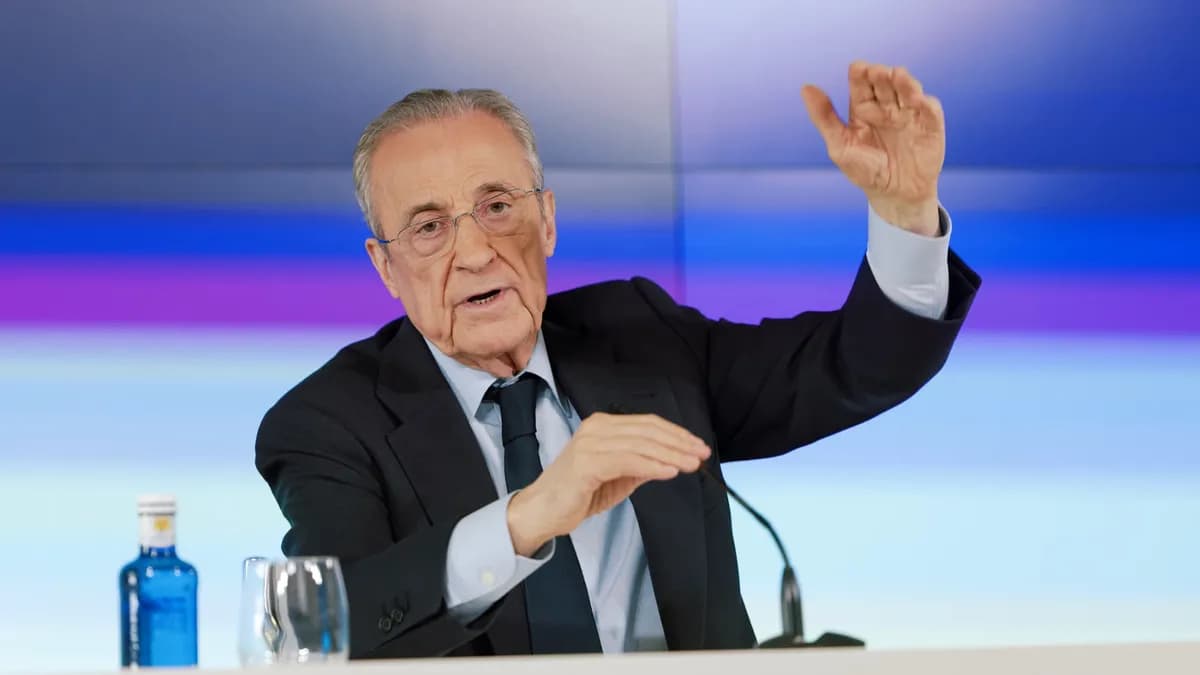
Florentino Perez proposes free broadcasting of the Champions League: UEFA slows down this project
Florentino Perez, president of Real Madrid, suggested to UEFA an innovative model to broadcast the Champions League for free. However, this ambitious idea is not part of the current plans of the European football body.
A bold proposal from Florentino Perez for broadcasting the Champions League
Florentino Perez, an iconic figure of Real Madrid and influential in the world of European football, recently submitted to UEFA an innovative idea regarding the broadcasting of Champions League matches. According to the Spanish media Voz Pópuli relayed by RMC Sport, it would be a model allowing free access to the matches of this prestigious competition for all viewers.
This initiative, which could disrupt the traditional pay-to-view broadcasting methods, aims to expand the audience of the Champions League and modernize its access, in line with technological developments and the expectations of football fans in the digital age.
The concrete implications of free broadcasting for European football
If this model were adopted, it would allow a much larger number of supporters to access live matches, thus removing the financial barrier of subscriptions or paid rights. This could potentially increase overall engagement and strengthen the popularity of European football on an international scale.
For traditional broadcasters, however, such free access would challenge their economic model based on subscriptions and TV rights sales, raising questions about the long-term financial viability of the competition. Revenues from broadcasting rights indeed constitute a vital part of UEFA's and participating clubs' resources.
Moreover, offering free access to the Champions League could alter marketing strategies and commercial partnerships around the event, pushing stakeholders to invent new monetization sources, notably through digital platforms and targeted advertising.
Why UEFA is slowing down this initiative
Despite the enthusiasm this proposal may generate, UEFA does not currently plan to change its broadcasting model, as specified by RMC Sport. The priority remains the preservation of revenues generated by TV rights, which help finance the development of European football, notably national competitions and training programs.
Furthermore, the complexity of current contracts with broadcasters and the necessity to ensure optimal broadcast quality represent significant obstacles to switching to free access. UEFA must also manage the expectations of various economic stakeholders involved to guarantee a balance between accessibility and profitability.
A context of transformation of sports rights in Europe
Florentino Perez's proposal comes in a context marked by rapid evolution in the consumption modes of sports content, where competition between OTT platforms, traditional channels, and social networks is intensifying. European football is at the heart of these transformations, with colossal financial stakes and a fierce battle to capture fans' attention.
Moreover, some competitions are already exploring free or hybrid broadcasting alternatives, notably to reach younger generations, but the Champions League, as a flagship product, remains highly protected in its economic model.
The historical roots of Real Madrid and its influence on the Champions League
Real Madrid is inseparable from the history of the Champions League, a competition it has dominated several times since its creation in 1955. As the most decorated club, it has helped shape the image and reputation of this competition, attracting a global audience. Florentino Perez's stature as club president gives him major influence in decisions within European football.
This influence also translates into a constant desire to modernize and innovate in how football is consumed, notably through the media. The free broadcasting proposal fits into this logic, aiming to make the competition accessible to an ever wider audience while adapting to new digital usages.
Tactical and sporting stakes around expanded broadcasting
Beyond economic aspects, free broadcasting could have an indirect impact on the tactical and sporting strategies of clubs participating in the Champions League. A larger audience means increased exposure for players and teams, which can influence media pressure and supporters' expectations.
This increased visibility could push coaches to adapt their approaches to appeal to a global audience, favoring a more attractive and offensive style of football. Moreover, clubs could benefit from enhanced image valuation, facilitating recruitment and talent retention.
Evolution prospects and impact on the European ranking
If free broadcasting were to materialize, it could alter financial balances between clubs, with a possible effect on the European ranking. Clubs best prepared to exploit new digital revenue sources would have a competitive advantage, potentially reshuffling the cards within national and continental competitions.
Additionally, a larger global audience would increase the visibility of lesser-known clubs, offering them a platform to boost their notoriety and attract new investors. However, the transition to this model would require profound structural adaptation and rigorous management to avoid destabilizing the current ecosystem.
A perspective: a risky but innovation-driven bet
Florentino Perez's proposal represents a bold bet on the future of sports broadcasting. While it could open the Champions League to a wider audience, it raises major questions about the financial sustainability of European football. The challenge will be to find a hybrid model capable of reconciling accessibility, quality of service, and sufficient revenues.
In this context, UEFA must carefully weigh the advantages and risks of such transformations while remaining attentive to technological developments and supporters' expectations. The stakes are high to maintain the competitiveness and attractiveness of the Champions League in a rapidly evolving global market.
In summary
Florentino Perez's proposal to offer free broadcasting of the Champions League is an innovative but complex idea to implement. While it promises increased accessibility and modernization of European football, it raises many economic and strategic questions. UEFA, guardian of the current model, remains cautious about this project, aware of the financial stakes and the expectations of various stakeholders. The transformation of sports rights in Europe is underway, and European football will have to adapt to remain both popular and viable in a constantly evolving audiovisual universe.