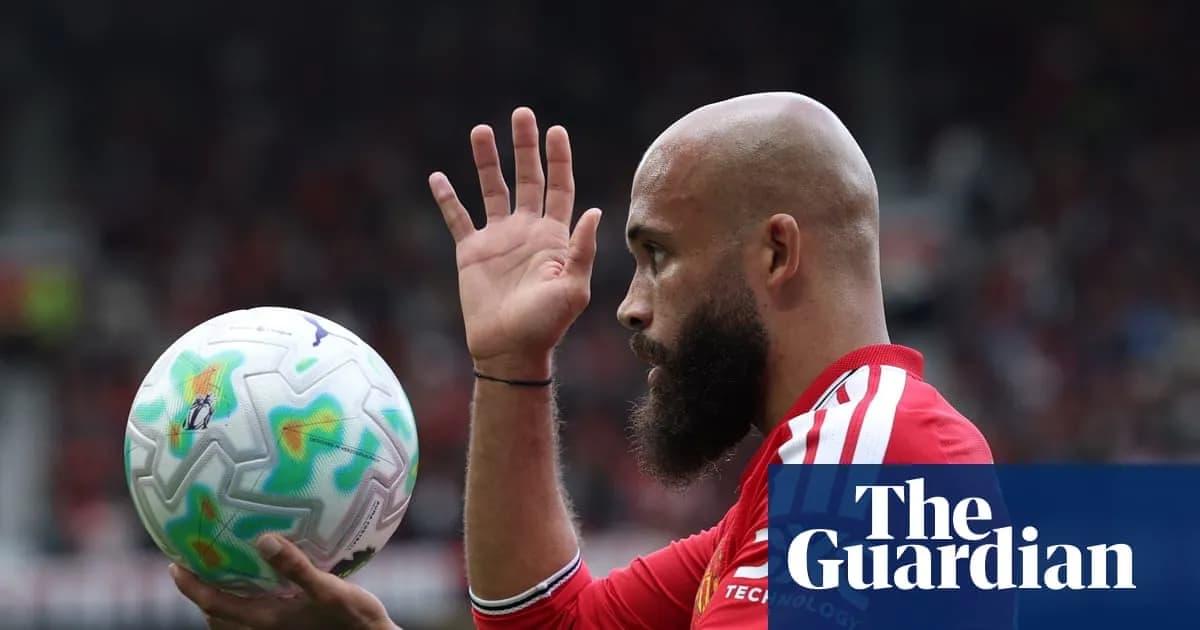
Howard Webb admits to a refereeing error on Mbeumo's hand in the Premier League
Howard Webb, head of professional referees, admitted that referee Michael Salisbury made a mistake by allowing a goal from Matheus Cunha despite a handball by Bryan Mbeumo. This disputed decision during the Manchester United - Nottingham Forest match sparks debate on the application of handball rules in the Premier League.
A refereeing error acknowledged on a decisive handball in Premier League
Howard Webb, head of officials at the Professional Game Match Officials (PGMO), publicly acknowledged a refereeing error concerning a goal scored by Matheus Cunha during the match between Manchester United and Nottingham Forest. Official Michael Salisbury had allowed this goal despite a handball by Bryan Mbeumo, Cunha's teammate, in the phase preceding the goal. This decision was ultimately judged incorrect by Webb, highlighting the complexity of applying handball rules in the Premier League.
This observation comes after the disputed goal contributed to Manchester United's 3-2 victory. According to Webb, the referee showed too much tolerance in interpreting players' natural movements, a dimension taken into account by the Premier League in applying the laws of the game.
The subtleties of handball rules in the Premier League
The Premier League applies a nuanced version of the handball rules, taking into account players' natural movements to avoid excessively strict decisions. However, in Bryan Mbeumo's case, Howard Webb believes the handball did not fall into this category, which should have led to the disallowing of Matheus Cunha's goal.
This case illustrates the refereeing difficulties linked to the inherent subjectivity of the handball law, regularly a source of controversy in modern football. The VAR (video assistant referee) intervention does not seem to have been sufficient to correct this decision, raising questions about the protocol and referee training in these specific situations.
This error has a direct impact on the course of the match and potentially on the standings, underlining the crucial importance of a rigorous and consistent interpretation of the rules.
Howard Webb and the challenges of referee training
As director of the PGMO, Howard Webb is responsible for the training and supervision of professional referees in England. His acknowledgment of Michael Salisbury's error is rare and demonstrates a willingness to improve refereeing quality, especially on high-stakes decisions.
This approach takes place in a context where the Premier League seeks to minimize refereeing errors while maintaining fluidity in the game. VAR protocols are regularly evaluated and adapted to better assist officials in complex cases like this one.
A decision that reignites the debate on refereeing and handball
The controversy around Bryan Mbeumo's handball revives the debate on the consistency and transparency of refereeing decisions in the Premier League. This case highlights the difficulty of reconciling the subjectivity of human judgment with the available technological tools.
Specialists and supporters now expect concrete measures to prevent such errors from recurring, especially as the English competition remains one of the most followed and scrutinized leagues in the world.
Our analysis: towards an evolution of VAR protocols?
Howard Webb's official acknowledgment of the error could encourage the Premier League to review its VAR usage protocols, particularly for handball infractions. A clearer clarification of interpretation criteria would be necessary to ensure a more uniform application of the rules.
This case also illustrates the increasing pressure on elite referees, who must officiate according to evolving rules and under the constant scrutiny of cameras and experts. Enhanced training and more efficient decision-support tools could be the next step to further professionalize this field.
In short, this publicly acknowledged refereeing error is an opportunity for English football to progress towards better sporting justice, a sine qua non condition to preserve the credibility and attractiveness of the Premier League.
Historical context and stakes for Nottingham Forest
Nottingham Forest, a historic English football club, is going through a pivotal period since its return to the Premier League after several years in lower divisions. This match against Manchester United represented a crucial opportunity to accumulate points against a renowned opponent in a tight relegation battle. Every point counts in this decisive phase of the season, and a goal tainted by an unpunished handball can influence not only the result but also the team's psychological dynamic.
The club, which experienced its glory days in the 1970s with remarkable European successes, is now seeking to regain sporting and financial stability. The involvement of controversial refereeing decisions at this stage of the competition adds extra pressure on players and staff, who must manage both on-field performance and off-field debates.
Tactical impact and consequences on the standings
From a tactical standpoint, Bryan Mbeumo's handball and the allowance of Matheus Cunha's goal changed the course of the match in favor of Manchester United. This situation forced Nottingham Forest to adopt a more offensive style in the final minutes, thus exposing their defense to quick counterattacks. The final score of 3-2 reflects an intense match where every mistake was exploited.
In the standings, this defeat can have significant repercussions, especially in the fight to avoid relegation. Points lost in such tight matches can weigh heavily at the end of the season, increasing pressure on struggling teams. The question of refereeing fairness thus becomes central in the overall analysis of performances and results.
Perspectives and recommendations for the future
In light of this controversy, the Premier League and PGMO are encouraged to strengthen referee training, focusing particularly on complex handball situations. Improving communication between on-field referees and VAR officials could also help reduce errors.
Moreover, revising VAR intervention protocols with a clearer definition of infraction criteria would increase decision consistency and ease tensions among clubs and supporters. Finally, this case underlines the importance of increased transparency in error management to preserve trust in refereeing and the competition.
In summary
Howard Webb's acknowledgment of a refereeing error on Bryan Mbeumo's handball that led to a decisive goal is a rare event that highlights the ongoing challenges of refereeing in the Premier League. This decision not only influenced the outcome of a key match between Manchester United and Nottingham Forest but also reignites the debate on rule application and VAR effectiveness. For Nottingham Forest, this context occurs during a critical phase of their season, with major sporting and psychological stakes. In the longer term, this case could encourage an evolution of refereeing protocols aimed at ensuring more rigorous and transparent sporting justice in the English championship.