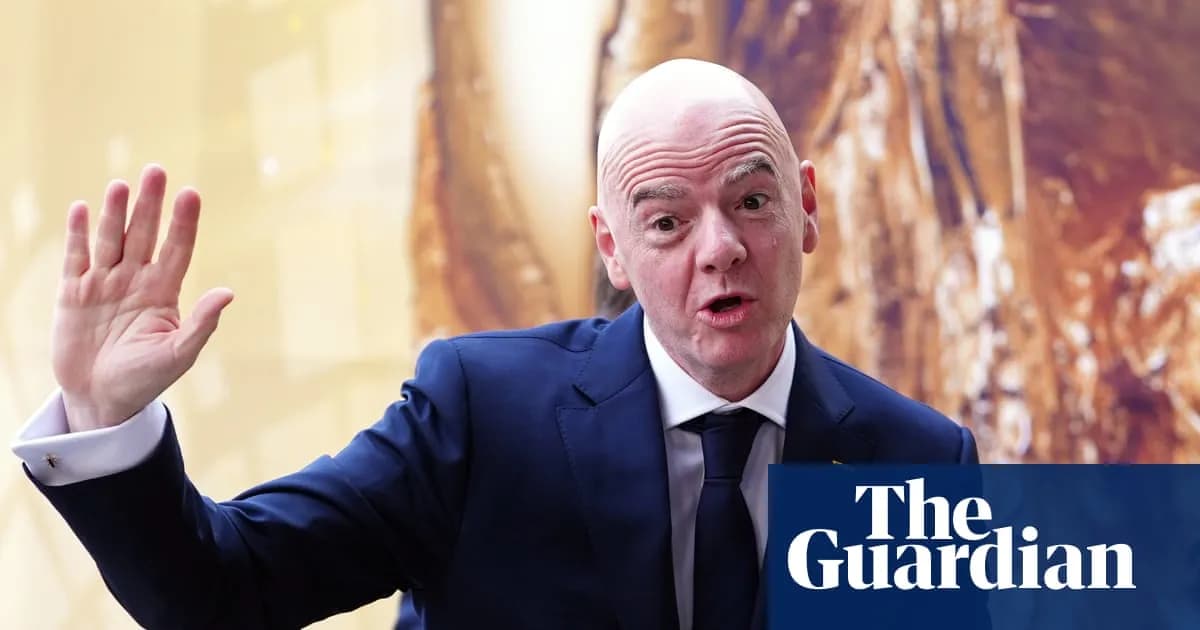
Infantino crashes CFU meeting and angers Concacaf federations
Gianni Infantino hijacked a Caribbean Football Union meeting to announce development projects, despite Victor Montagliani's request that he not attend. Several Concacaf members are furious at this behavior, which they see as opportunistic.
FIFA president Gianni Infantino has sparked a major controversy by hijacking a Caribbean Football Union (CFU) meeting for his own benefit, according to reports from The Guardian. This move, seen as an attempt to consolidate support ahead of his re-election, has provoked outrage among several Concacaf member nations, who saw their long-awaited development projects used as campaign tools.
Behavior deemed unacceptable by Concacaf members
According to several sources present at the CFU meeting, held in the Dominican Republic, many representatives of Concacaf member federations expressed their indignation at Infantino's attitude. Concacaf president Victor Montagliani had explicitly asked Infantino not to attend this meeting, a request that was ignored. This disregard for the regional body's wishes is seen as a sign of arrogance and political calculation. Tensions were palpable, with some delegates going so far as to describe this intrusion as a "meeting hijack" and a "blatant lack of respect" for established procedures.
It should be recalled that Concacaf, which brings together the federations of North America, Central America, and the Caribbean, has always sought to preserve its autonomy in the face of FIFA's growing influence. This already complex relationship has been severely strained by this incident, which comes amid delicate negotiations over revenue distribution and the international match calendar. Caribbean federations, in particular, have often expressed frustration with FIFA's administrative delays, and Infantino's gesture has reignited these grievances.
Development projects announced with long-awaited funds
Infantino took the opportunity to unveil a series of development projects for Caribbean countries, funded by FIFA. These announcements, while potentially beneficial for the region, were poorly received because they seemed opportunistic. The promised funds were in fact already allocated, but their release had been delayed for several months, causing frustration and impatience among local federations. By presenting them personally, Infantino seeks to take credit for these investments, a strategy that is all the more irritating given that these delays had been strongly criticized by Caribbean leaders.
The announced projects notably include the construction and renovation of sports infrastructure, training programs for young players and coaches, as well as initiatives aimed at improving local governance. However, the specific details of these projects have not been disclosed, and the federations concerned are still awaiting clarification on the implementation modalities. Some delegates pointed out that these announcements could have been made during official Concacaf meetings, rather than being used as a campaign tool.
This situation highlights the challenges of global football governance, where political and sporting interests are often intertwined. FIFA, as the supreme body, must find a balance between developing football in less favored regions and respecting the prerogatives of confederations. The CFU incident illustrates the persistent tensions between the global and regional levels, and raises questions about the transparency and legitimacy of decisions made at the highest level.
This intrusion into Concacaf's affairs comes as Gianni Infantino prepares for his re-election as FIFA president. He is seeking to secure the support of Caribbean federations, which represent a significant voting bloc. However, this heavy-handed approach could backfire. Several delegates have expressed their displeasure and might be tempted to support a challenger at the next congress. Concacaf, under Victor Montagliani's leadership, could also harden its stance toward FIFA, demanding guarantees on respect for regional autonomy.
It is important to note that Infantino's re-election is not a foregone conclusion. Although he secured the support of several confederations during his first term, recent controversies, notably over the 2034 World Cup and governance reforms, have weakened his position. Caribbean federations, which represent about a third of the votes at the FIFA congress, could play a key role in the outcome of the ballot. Their discontent could prompt other confederations to question the current leadership, opening the door to an alternative candidacy.
The coming weeks will be decisive in measuring the impact of this crisis on Infantino's re-election campaign. Caribbean federations could demand a public apology, or even concrete commitments on decentralizing decisions and accelerating the release of funds. FIFA, for its part, will have to manage this diplomatic crisis carefully, lest its authority be challenged by regional confederations.
What consequences for global football governance?
This incident highlights the growing tensions between FIFA and its regional confederations. Concacaf, like other bodies, seeks to preserve its autonomy in the face of FIFA's growing influence. The reaction of Caribbean federations could have repercussions on future negotiations concerning the international match calendar, governance reforms, or revenue distribution. The coming weeks will be decisive in measuring the impact of this crisis on Infantino's re-election campaign.
Beyond the political aspect, this incident raises questions about how FIFA manages its relations with smaller federations. Caribbean countries, often faced with economic and logistical challenges, need support, but they want to be treated with respect and consideration. By acting unilaterally, Infantino risks compromising years of work to strengthen FIFA's credibility and alienating potential allies.
Observers note that this situation is reminiscent of other episodes in FIFA's recent history, where decisions made at the top were perceived as attempts at excessive control. Global football governance is a delicate balance between the interests of major confederations and those of smaller nations, and any imbalance can have lasting consequences. The CFU incident could thus serve as a catalyst for deep reform of FIFA's decision-making mechanisms.
In conclusion, Gianni Infantino's maneuver at the CFU meeting not only offended Concacaf members, but also highlighted the fragilities of global football governance. As the campaign for the FIFA president's re-election intensifies, this incident could well influence the votes of Caribbean federations and redraw the power balances within the governing body. The coming weeks will be crucial in determining whether this crisis will be overcome or whether it will leave lasting scars on relations between FIFA and its confederations.