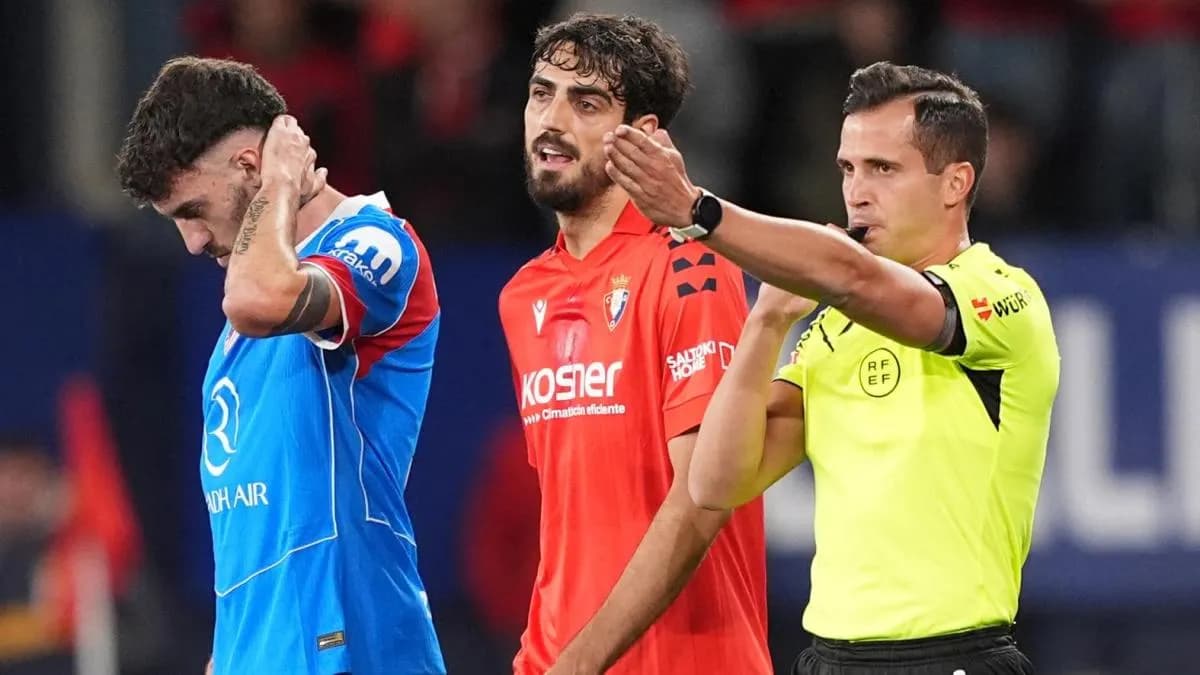
José Luis Guzmán Mansilla: How VAR Corrected Refereeing Errors Against Osasuna in La Liga
During the Osasuna-Atlético de Madrid match, referee José Luis Guzmán Mansilla missed two crucial penalty decisions in the first half, narrowly saved by the intervention of VAR. This case illustrates the stakes of using technology in Spanish football.
During the match between Osasuna and Atlético de Madrid at the El Sádar stadium, Andalusian referee José Luis Guzmán Mansilla had a difficult evening. According to an article from Mundo Deportivo, he missed two clear penalty decisions in the first half of the match. Without the intervention of VAR (video assistant referee), these errors could have heavily influenced the course of the game.
The use of VAR allowed these erroneous judgments to be corrected, thus avoiding unfair decisions on the pitch and preserving the integrity of the competition. This case highlights the growing importance of technology in modern refereeing, especially in demanding leagues like the Spanish La Liga.
Refereeing under high pressure in a competitive context
José Luis Guzmán Mansilla, in charge of the match, faced unusual pressure due to his initial errors. The first half was therefore marked by delicate management of refereeing decisions. The importance of penalty decisions in a La Liga context, where every point counts for the standings, underlines the seriousness of these potential errors.
Atlético de Madrid, a club regularly competing for the title, required precise refereeing. The fact that these errors were corrected by VAR also reflects the efforts made by La Liga to minimize human errors in high-stakes matches. This illustrates the complexity of the referee’s role and the need for complementary tools to ensure fairness.
The El Sádar stadium, usually the scene of an intense atmosphere, saw its course influenced by this technology, which now acts as a guarantee of impartiality in crucial decisions. This match is a concrete example of the challenges posed by live refereeing and shows how VAR has become an essential actor.
VAR: a technological system at the heart of sports justice
The VAR system is designed to assist referees in situations where the decision is unclear or contested, particularly on penalties, goals, red cards, and mistaken identity. In this match, it detected the two contentious situations that José Luis Guzmán Mansilla had initially misjudged.
This assistance relies on a series of high-definition cameras and a control center where specialist referees analyze images in real time to advise the main referee. This technical architecture significantly reduces the risk of serious errors but does not eliminate them entirely and still depends on the final judgment of the referee on the pitch.
VAR, although sometimes criticized for disrupting the flow of the game, is increasingly becoming a standard in major competitions, bringing a balance between the human dimension and technical precision. Its effectiveness in this specific case at El Sádar in the Spanish League demonstrates its crucial role in the professionalization of refereeing.
Widespread and improving use
Since its deployment in La Liga, VAR has been adopted to improve the quality of refereeing decisions. Referees like José Luis Guzmán Mansilla benefit from a safety net allowing them to correct their judgments in complex situations. The experience of this match illustrates the evolution of the relationship between man and machine in sport.
With regular updates to the usage protocol and enhanced training, the system continues to gain in accuracy and fluidity. These improvements are essential to maintain acceptance by players, coaches, and spectators, who expect impeccable sports justice.
A crucial issue for competitiveness in La Liga
The use of VAR in high-tension matches like Osasuna-Atlético de Madrid is fundamental to guarantee fair competition. La Liga, by supporting this technology, asserts its commitment to refereeing excellence and the fight against errors that could distort the standings.
For clubs like Atlético, often fighting for top positions, every refereeing decision can have a significant impact on the title race. VAR thus appears as a strategic tool to preserve the credibility and competitiveness of the championship.
Analysis and perspectives
This case shows how technology can save a referee from a nightmare evening while highlighting the current limits of the human system. José Luis Guzmán Mansilla failed to identify the penalty fouls, but the presence of VAR prevented major errors.
Dependence on VAR, however, raises questions about the training and trust given to referees. It is necessary to balance technology and human authority so as not to distort the fundamental role of the referee. Nevertheless, the trend is clear: modern football increasingly relies on technological tools to guarantee sports justice.
This match at El Sádar will remain a striking example of how VAR can influence the course of a game by correcting refereeing errors that, without it, could have changed the course of La Liga.