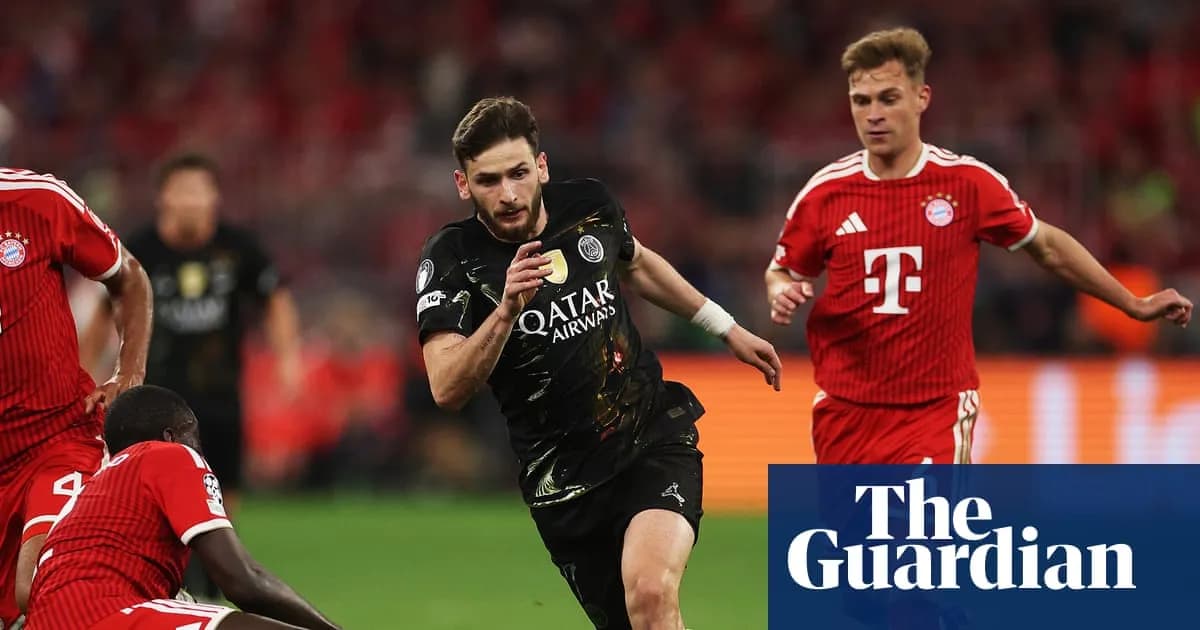
Khvicha Kvaratskhelia: PSG's Sharp Offensive Weapon in the 2026 Champions League Semi-Final
Khvicha Kvaratskhelia established himself as a true offensive scalpel for PSG during the first leg of the Champions League semi-final against Bayern Munich. His creativity and dribbling significantly disrupted the Bavarian defense, demonstrating a new dimension in the Parisian attack.
An Offensive Display of Virtuosity Against Bayern Munich
During the first leg of the Champions League semi-final between Paris Saint-Germain and Bayern Munich, Khvicha Kvaratskhelia shone with his ability to destabilize the opposing defense. According to The Guardian, his creativity and imagination gave Konrad Laimer, a midfielder known for his solidity in the Bundesliga, a hard time. This performance highlights Kvaratskhelia's growing importance in PSG's offensive setup, already praised for its precise and effective play.
The match, described as an exceptional spectacle, saw PSG dominate their opponent from the opening minutes. Bayern never really managed to impose their rhythm, suffering from the technical and tactical superiority of Paris, notably thanks to Kvaratskhelia's decisive contribution.
Kvaratskhelia's Key Role in Parisian Offensive Strategy
Kvaratskhelia's profile fits perfectly within Luis Enrique's playing philosophy, which relies on fluid and sharp attack. Able to combine dribbling, acceleration, and creativity, the Georgian has become an indispensable element for opening gaps in compact defenses like Bayern's. His impact is not limited to chance creation: he also influences how the opposing team structures its defense, forcing important tactical adaptations.
In a context where PSG seeks to maximize its offensive talents, having a player capable of improvising and surprising is a major asset. Kvaratskhelia represents this attacking "scalpel," ready to exploit every weakness with precision and speed, thereby reinforcing the Parisian team's reputation for surgical efficiency.
This ability to unbalance the opponent is particularly valuable against top-level teams that master defensive phases well. The display against Bayern Munich attests to this, with a player who knew how to create opportunities and constantly pressure the Bavarian defense.
An Illustration of PSG under Luis Enrique
The style of play implemented by the Spanish coach is characterized by intense pressing and fast, precise offensive movement. Kvaratskhelia, through his technical profile and creativity, fits ideally into this scheme. His individual talent complements the collective cohesion, allowing PSG to excel in high-intensity matches such as those in the Champions League.
PSG's success in this first leg semi-final can also be understood through this alchemy between collective and individual qualities, embodied by Kvaratskhelia but also by other key players like Ousmane Dembélé, who scored an early goal that put his team on the right track. Such performances confirm PSG's rise in European competition.
Historical Context of PSG in the Champions League
Paris Saint-Germain, founded in 1970, long sought to establish itself on the European stage, often hindered by prestigious opponents. Since Luis Enrique's arrival in 2023, a new dynamic has been established, combining experience and offensive freshness. The Champions League, the most prestigious competition in European football, represents a major goal for the Parisian club aspiring to its first major title in this tournament. Each milestone, notably this semi-final against Bayern Munich, marks significant progress in PSG's history, which now intends to compete with the greatest.
The confrontation with Bayern fits into this quest for European legitimacy. The Bavarian club, five-time Champions League winner, is a renowned opponent testing PSG's solidity and maturity. Kvaratskhelia's performance in this context highlights not only his individual talent but also PSG's ability to adapt and excel against the continent's best teams.
Tactical Stakes and Impact on European Ranking
Tactically, the duel between PSG and Bayern is a demonstration of opposing strategies: Luis Enrique's fluid and dynamic approach versus Bavarian rigor and discipline. Kvaratskhelia plays a central role in this battle, exploiting spaces and forcing the repositioning of opposing defensive midfielders. His ability to create imbalances forces Bayern to react, opening opportunities for his teammates.
The result of this first leg, favorable to PSG, has a considerable impact on the club's European journey. It boosts the group's confidence and improves their chances of qualifying for the final, while influencing the club rankings within UEFA, which can affect future draws and PSG's visibility. This victory consolidates the club's place among the European elite, enhancing its attractiveness to players and sponsors.
Perspectives and Stakes for the Rest of the Competition
As PSG continues its path in the Champions League, Kvaratskhelia's contribution will be a determining factor. His ability to create imbalance against the strongest defenses could prove crucial in the return matches and potential future confrontations. According to The Guardian, this performance already warns teams like Arsenal, who will have to be wary of his presence.
The outcome of this semi-final remains to be confirmed with unconfirmed information at this stage regarding the final results, but Kvaratskhelia's impact on Parisian play is a factual element that redefines the club's ambitions in this 2026 edition. His role as a sharp offensive weapon is now indisputable.
In Summary
Khvicha Kvaratskhelia's performance against Bayern Munich perfectly illustrates the evolution of Paris Saint-Germain under Luis Enrique's era. Combining creativity, speed, and tactical intelligence, he embodies the offensive weapon capable of making a difference at key moments. This performance, at the heart of a match where PSG dominated its prestigious opponent, confirms the club's rise in European competition. As the team looks ahead to the end of the season, Kvaratskhelia's influence will be a major asset in facing upcoming challenges, in an ever more ambitious quest for continental glory.