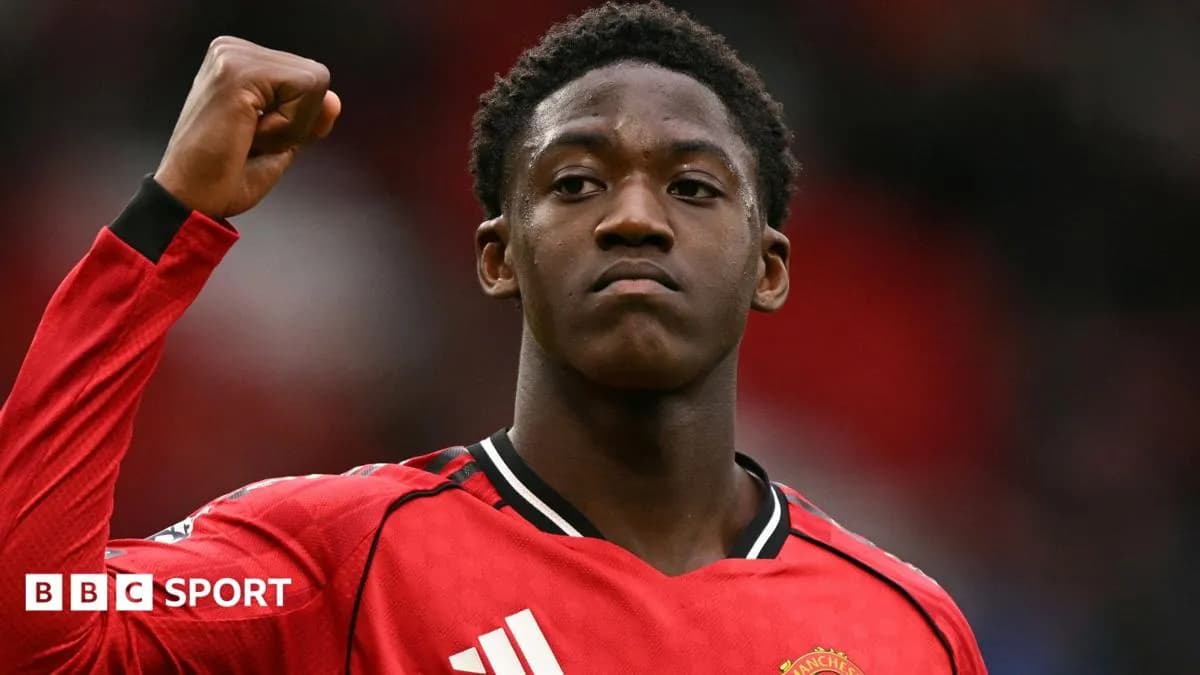
Kobbie Mainoo extends contract at Manchester United until 2031: what impact for the club in the Premier League?
Manchester United secures Kobbie Mainoo's future with a contract extended until 2031. This signing highlights the club's confidence in his potential and strengthens its strategy of developing young talents in a competitive Premier League context.
Manchester United confirms its long-term commitment to Kobbie Mainoo
Manchester United has officially extended the contract of Kobbie Mainoo, a promising young midfielder, until 2031, according to a statement reported by BBC Sport Football. This strategic decision aims to firmly anchor the player at Old Trafford, demonstrating a clear willingness to invest in talents from its academy amid strong competition in the Premier League.
Signing such a long contract, which extends over five additional seasons, reflects the club's confidence in Mainoo's ability to establish himself as a key squad member in the medium and long term. This choice also fits into Manchester United's broader policy of renewing its squad with high-potential profiles.
Kobbie Mainoo, who has already made his first-team debut, now benefits from contractual stability that should facilitate his gradual integration into the starting eleven. By extending his commitment until 2031, Manchester United is creating ideal conditions to develop his technical and tactical qualities within a competitive Premier League environment.
This approach is accompanied by Manchester United's desire to compete with other major European clubs by balancing experience and youth. Mainoo could thus become an essential link in Manchester United's midfield in the coming seasons.
The extension comes at a time when the club seeks to consolidate its performances after several seasons marked by mixed results, according to available data. Strengthening the squad with young talents like Mainoo is a direct response to the high demands of the Premier League.
A training and retention strategy at the heart of the sporting project
The renewal of Kobbie Mainoo's contract illustrates Manchester United's strategy combining internal training and gradual squad renewal. This policy is designed to reduce dependence on costly transfers and promote sustainable development.
By committing long-term, the club secures an asset whose sporting and economic value could grow significantly, especially if Mainoo confirms his potential on the national and international stage.
This type of contract also helps strengthen team cohesion and sends a strong signal to other young academy players by valuing internal progression.
Consequences for the Premier League and the transfer market
In a championship as competitive as the Premier League, managing young talents is crucial. By locking Mainoo in until 2031, Manchester United positions itself to reduce the risk of premature departures amid interest from other powerful clubs.
This approach can also influence the internal transfer market by limiting immediate recruitment needs in his position and giving the club budgetary leeway for other priorities.
The historical context of Manchester United and its positioning in the Premier League
Manchester United, a legendary English football club, has always been recognized for its ability to develop young talents and build competitive teams capable of competing at the highest level. Founded in 1878, the club has gone through various eras, often marked by major successes, notably under the leadership of iconic managers. In a demanding championship like the Premier League, competition is fierce, and the ability to integrate academy players into the first team has often made the difference.
After several seasons of relative instability, Manchester United seeks to reconnect with its historical prestige by developing a sporting policy focused on youth and stability. Kobbie Mainoo's signing fits within this desire to build a sustainable team capable of performing long-term and meeting the tactical challenges posed by championship rivals.
Tactical challenges and Mainoo's potential role in the team
Kobbie Mainoo plays as a midfielder, a key area in building play and managing transitions between defense and attack. His ability to combine technical skill, game vision, and physical endurance could become a major asset for Manchester United, especially in tactical systems favoring possession and quick ball recovery.
The club could consider assigning him a box-to-box or deep-lying midfield role, where his versatility would help balance the team between defensive and offensive phases. This tactical integration will need to be gradual, given the pressure and demands unique to the Premier League, so that Mainoo can adapt to the high pace and intense duels of the championship.
Prospects for the standings and future ambitions
Consolidating players like Kobbie Mainoo in the squad is also an important lever for Manchester United's sporting ambitions. By structuring its team around promising young talents, the club hopes to regain consistency in its performances and thus establish itself sustainably among serious contenders for European places and national titles.
This strategy could also have positive effects on the collective dynamic and team motivation, instilling an internal competitive spirit and a distinct identity. If Mainoo and his peers manage to establish themselves, Manchester United could gradually close the gap with its rivals and envision a new era of success in the Premier League and on the European stage.
In summary
Kobbie Mainoo's contract extension fits into a long-term consolidation logic for Manchester United, which is betting on a local talent to strengthen its sporting project. However, the success of this commitment will depend on the player's ability to take the next step in the Premier League, a challenge requiring consistency and adaptation to a high level of demand.
If Mainoo manages to establish himself sustainably, this operation could prove to be a model for training and talent management policies in modern football. Meanwhile, the club has clearly displayed its ambitions for 2026 and beyond.