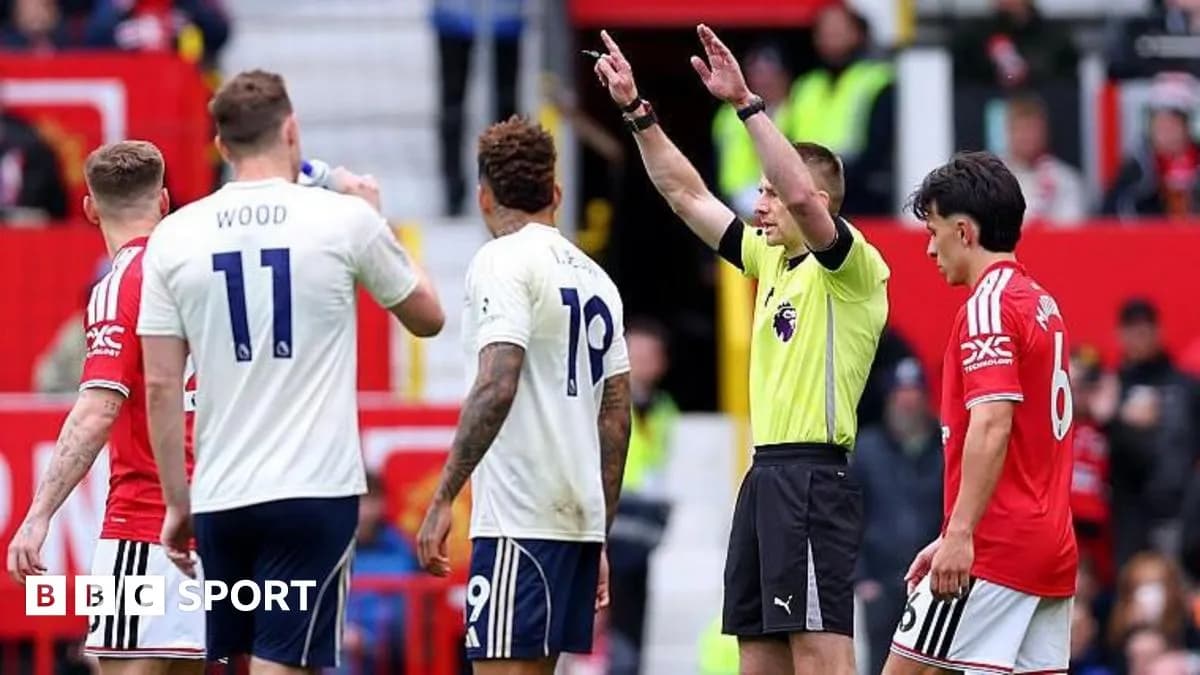
Involuntary Handball by Mbeumo: Should the Handball Law in the Premier League Be Reviewed?
The acceptance of a goal scored after an accidental handball by Bryan Mbeumo has caused confusion among experts and supporters. This new episode raises crucial questions about the clarity and application of handball rules in the Premier League.
A new controversial case of accidental handball in Premier League
English football has once again been the scene of a refereeing decision that divides opinion. During a recent match, a goal scored by Matheus Cunha was allowed despite a hand deemed "accidental" by Bryan Mbeumo during the course of the action. This decision, reported by BBC Sport Football, deeply puzzled analysts, players, and supporters, illustrating the ongoing difficulties related to the interpretation of the handball law.
In a context where strict rules are supposed to guarantee fairness, this case highlights the complexity of determining when a handball should be penalized. According to the source, Mbeumo's hand was not judged to be intentional, which led to the goal being allowed. This refereeing choice, although in line with the letter of the law, is perceived as a "mess" by experts, highlighting an inconsistency in the application of the rules.
Technical and regulatory issues of handball in the Premier League
FIFA's handball regulations stipulate that only hands or arms used voluntarily to control or touch the ball should be penalized. However, the distinction between intentional and accidental handball remains very subjective. In Bryan Mbeumo's case, the referees considered the contact with the ball to be involuntary, thus allowing Cunha's goal.
This situation illustrates the limits of human interpretation and current technology, such as the Video Assistant Referee (VAR). Despite its use, VAR did not allow for a definitive ruling, leaving room for uncertainty. This ambiguity harms the flow of the game and confidence in refereeing decisions, essential elements for a championship as widely followed as the Premier League.
Moreover, the controversy is part of a series of similar incidents over recent seasons, which have prompted several voices to call for a reform of the handball rules. Critics denounce a legal framework that is too vague, leaving too much discretion to referees and weakening the perception of fairness among football stakeholders.
Towards a necessary reform of the handball law?
The controversy surrounding Matheus Cunha's goal could reignite the debate on the need to adapt the handball law. Several experts and former players advocate for clarifying the criteria, or even simplifying the rules to avoid these ambiguous situations. Some notably propose integrating a precise tolerance threshold regarding arm position or the impact of contact.
On the side of the authorities, such a reform would require thorough consultation between FIFA, the IFAB (International Football Association Board), and major leagues like the Premier League. The goal would be to harmonize interpretations and strengthen the consistency of refereeing decisions, while preserving the essence of the game.
Furthermore, technological evolution could also play a role. The development of more sophisticated analysis tools, capable of determining the nature of contact with increased precision, would offer valuable support to referees. This progress would reduce subjectivity and improve the transparency of decisions.
Impact on the game and supporters' perception
Beyond the regulatory aspect, these controversies directly affect the relationship between football, its actors, and its fans. Trust in refereeing is a fundamental pillar of the competition. When a key decision appears inconsistent or unfair, it fuels frustrations, media controversies, and can even influence the course of a championship.
The Premier League, which enjoys a considerable global audience, is particularly exposed to these debates. The perceived quality of the spectacle also depends on the credibility of refereeing decisions. Thus, the management of handball remains a major issue to preserve the integrity of the championship and the engagement of supporters.
Finally, this situation raises broader questions about the balance between football tradition and the integration of modern technologies and rules. Finding a viable compromise appears as a challenge for sports authorities.
Historical context and stakes for the clubs involved
Since its creation in 1992, the Premier League has established itself as one of the most competitive and followed championships in the world, characterized by a high level of demand both technically and regulatory. Clubs involved in these controversies often experience intense seasons where every point counts for qualification in European competitions or the fight against relegation.
In this context, a contested refereeing decision can have a strong psychological and strategic impact on teams. For example, a goal allowed despite an accidental handball can change the rhythm of the match, influence coaches' tactical choices, and weigh heavily on the final standings, where the slightest mistake can be costly.
Clubs must thus adapt to this changing context, where the management of rules and their interpretation can become key factors of success or failure. Regulatory instability on handball complicates preparation and decision-making on the field, increasing pressure on players and technical staff.
Tactical issues and prospects for evolution
On a tactical level, the handball question directly influences how teams defend and attack. Defenders must now be extremely vigilant about the position of their arms and their movements in the penalty area, while attackers may try to take advantage of this ambiguity by seeking to provoke involuntary contacts to gain advantages.
This dynamic changes the game, sometimes to the detriment of its fluidity and spontaneity, as players may be hesitant or overly cautious. Coaches must integrate these constraints into their tactical schemes, which complicates match management, especially in crucial moments.
In the medium term, the prospect of regulatory reform could encourage harmonization of practices and better understanding of the rules by all actors. This would stabilize strategies and improve the quality of the spectacle, while reducing recurring controversies. The Premier League, at the forefront of innovation, could thus serve as a model for other championships.
In summary
The recent case of Bryan Mbeumo's accidental handball, validating Matheus Cunha's goal, illustrates the current flaws in the handball regulations in the Premier League. As highlighted by BBC Sport Football, this decision puzzled the football community, revealing an urgent need for clarification.
While the current law seeks to distinguish intentional from accidental handball, its implementation remains too subjective, weakening the consistency of decisions. A reform incorporating more objective criteria, accompanied by advanced technological tools, would be a necessary step to restore trust and guarantee fairness.
In the meantime, clubs, players, and fans will have to cope with this gray area that is an integral part of modern football, where video refereeing and rules constantly evolve but still struggle to resolve all ambiguities.