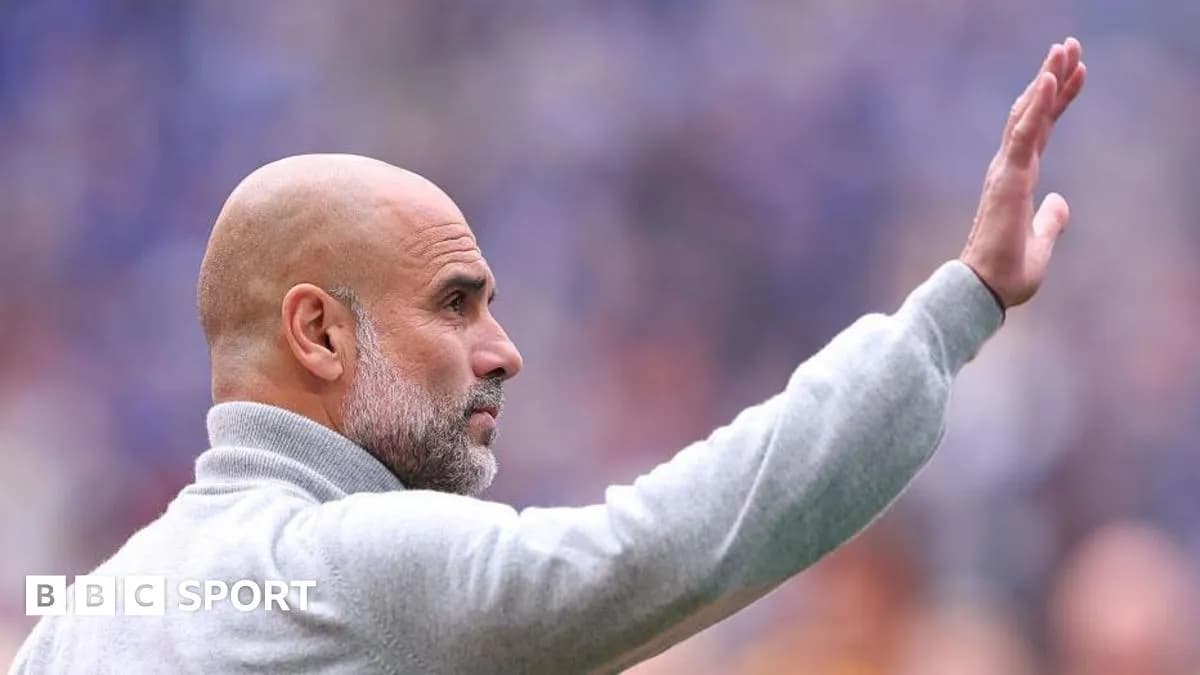
Manchester City Prepares for Pep Guardiola's Departure After Ten Years and 17 Major Trophies
After a decade crowned with success, Manchester City anticipates Pep Guardiola's departure at the end of the season. The club is preparing for a major transition after winning 17 trophies under his leadership.
End of an era: Manchester City prepares for Pep Guardiola's departure
Manchester City is gearing up for the end of the Pep Guardiola era, as he is set to leave the club at the conclusion of the season after ten years at the helm of the first team. This decision marks the end of an exceptional decade during which the Spanish coach led the club to an impressive total of 17 major trophies, solidifying the Citizens' place among the global football elite.
According to BBC Sport, this departure is not a complete surprise but a step anticipated by the Manchester management who are already planning the succession to ensure sporting continuity. The Guardiola cycle, which began ten years ago, has transformed the very identity of the club, both tactically and in its international stature.
An exceptional record in the Premier League and on the European stage
In ten years, Pep Guardiola has enabled Manchester City to establish itself sustainably in the Premier League, an extremely competitive and constantly evolving competition. Although the specific details of the titles won this season are not confirmed at this stage, the total collection of 17 trophies includes several English championship titles, national cups, and successes in the Champions League, according to available data.
This longevity at the top is rare in modern football, where the pressure and demands of top-level clubs often lead to frequent managerial changes. The stability offered by Guardiola has allowed City to establish an innovative and recognized playing philosophy, based on possession, intense pressing, and tactical versatility.
The announced departure raises the question of sporting continuity at Manchester City, particularly regarding recruitment strategy and maintaining European ambitions. Managing this transition will be crucial for the club, which aims to remain competitive against increasingly powerful rivals.
Strategic reasons for the departure and prospects for Manchester City
Although the exact reasons for Guardiola's departure are not explicitly detailed, several analysts mention a mutual desire to begin a new phase after a decade of success. The club seems ready to open a new chapter while capitalizing on the legacy left by the Spanish coach.
Guardiola's succession is a major challenge for Manchester City, which will need to identify a coach capable of perpetuating the offensive and rigorous philosophy established, while bringing a fresh breath. The choice of successor will condition the sporting trajectory and the club's ability to maintain its rank among the leaders of European football.
Moreover, this transition occurs in a context where financial and sporting demands continue to grow, especially in the Champions League, a competition City aims to win again. The club will therefore have to combine tactical innovation and rigorous squad management to maintain its level of excellence.
Consequences for the transfer market and internal organization
Guardiola's departure will also impact the club's recruitment policy and internal organization. Indeed, the Catalan coach has always had a decisive influence on the profile of recruited players, favoring those who fit his specific playing style.
With a new coach, the transfer strategy could evolve, changing priorities in terms of profiles and positions to strengthen. This uncertainty is a key element to watch in the coming weeks as the current season approaches its conclusion.
Historical context of the club and evolution in the Premier League
Manchester City, once perceived as a second-tier club in England, has undergone a radical transformation over the past two decades, notably after the arrival of investors and the appointment of Pep Guardiola. Before this period, the club often oscillated between the first and second divisions, far from the European summits. Guardiola's tenure marked an era of intense professionalization, where the pursuit of excellence and massive investments allowed competing with Europe's biggest clubs.
This evolution fits within the context of a Premier League in constant mutation, becoming one of the most competitive and media-covered championships in the world. Manchester City's ability to establish itself sustainably in this championship testifies not only to the quality of its squad but also to the solidity of its sporting project, now recognized internationally.
Tactical challenges: sustaining an innovative playing identity
On the tactical level, Guardiola has deeply marked Manchester City with his approach focused on ball possession, high pressing, and flexibility of playing schemes. His ability to adapt his strategies according to opponents and situations has made City an unpredictable and formidable team.
The challenge for the next coach will be to maintain this strong identity while injecting novelties to avoid any form of stagnation. Tactical continuity is essential to maintain the club's high standards, but innovation must also be at the heart of the sporting project to meet the growing demands of European competition, where opponents constantly develop new approaches.
Potential impact on rankings and future ambitions
Guardiola's departure could have a significant impact on Manchester City's ranking, both short and medium term. The transition between two eras often involves an adjustment period, with sometimes erratic results. Nevertheless, the club's financial solidity and the quality of its squad provide a solid base to limit the risks of decline.
The club's ambitions remain very high, especially in the Champions League, where Manchester City aims to confirm its status as a serious title contender. The success of this transition will largely depend on the club's ability to maintain its level of sporting demand and effectively manage the challenges related to the coaching change.
In summary
Pep Guardiola's departure marks a major turning point in Manchester City's recent history. After ten years of almost uninterrupted dominance and 17 major trophies, the end of his tenure opens a period of uncertainty but also opportunities. The club must now succeed in combining respect for the legacy and innovation to perpetuate its success.
The management's ability to handle this transition, notably through the choice of the next coach, will be decisive for the Citizens' sporting future. This pivotal moment could redefine the internal dynamics and the club's competitiveness on the national and European stage.