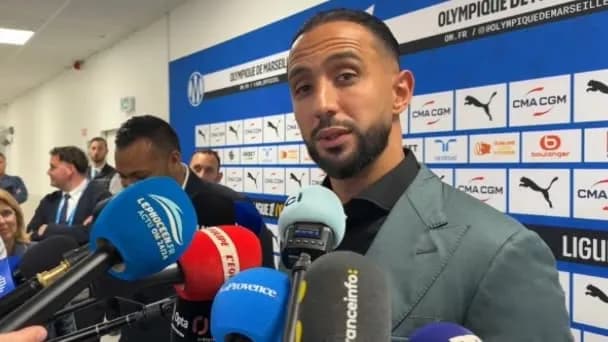
Medhi Benatia vs Waldermar Kita: Leadership and Presence in Ligue 1 Face to Face
Medhi Benatia, football director of OM, criticized the absence of FC Nantes' leaders during the last match of the season. This face-to-face analyzes their respective involvement in the management and dynamics of their clubs in Ligue 1.
Professional football is as much a matter of the field as it is of behind-the-scenes management. This comparison puts two emblematic figures of French football face to face: Medhi Benatia, then football director at Olympique de Marseille, and Waldermar Kita, president of FC Nantes. Their respective stances during key events of the season illustrate two different approaches to leadership in modern football.
After OM's qualification for the Europa League, Benatia took advantage of his last conference as sporting director to send a clear message regarding the commitment of the club's leaders. This implicit jab at Kita, absent from Nantes' last match, raises the question of the role and visibility of leaders in the performances and dynamics of Ligue 1 clubs.
A former international defender, Medhi Benatia took a strategic turn by joining Olympique de Marseille as football director. His role extends from recruitment to sports management, contributing to the structuring and competitiveness of the Marseille squad. His direct involvement in club events, notably during the last match against Rennes, demonstrates his total commitment to collective success.
During this match, OM won 3-1, thus securing qualification for the Europa League, a significant objective for the club. Benatia not only played a role behind the scenes but also showed his presence and leadership by facing the media to review the season and discuss future challenges. According to RMC Sport, he clearly expressed his disagreement with the attitude of Nantes' leaders, emphasizing the importance of being present at crucial moments.
Waldermar Kita is the president of FC Nantes, a historic Ligue 1 club. Since his arrival, he has driven a policy of financial and sporting stability, but his management style is often criticized for his visible absence during major events. This season, Kita's absence during the last match was noticed and commented on, notably by Medhi Benatia.
Under Kita's presidency, FC Nantes has experienced mixed periods, with management sometimes perceived as distant by supporters and observers. The fact that Nantes' leaders did not attend the last match of the season fueled debate about their real involvement in the club's life, a point Benatia did not fail to highlight in the press conference, emphasizing the need for constant physical and moral presence of the leaders.
Presence at key matches: Benatia present alongside the team during the last match, Kita absent.
Involvement in communication: Benatia held a review press conference, Kita remained discreet.
Perceived leadership: Benatia active and direct, Kita more distant, which provokes criticism.
Impact on the team: OM qualified for the Europa League with positive momentum, Nantes in a less favorable situation according to observers.
Sports management: Benatia involved in recruitment and strategy, Kita focused on administrative and financial management.
Context and Nuances
It is important to note that the respective roles of Benatia and Kita are fundamentally different: Benatia is a football director with a direct sporting and media role, while Kita is a president whose activity is often behind the scenes. Their visible involvement during matches reflects these distinct functions.
Moreover, the structural context of the two clubs differs considerably. OM, a club with strong media exposure and European ambitions, requires visible commitment from its sporting leaders. Nantes, a more modest club, can adopt a different approach, although the visibility of leaders has become an important criterion in public perception and team motivation.
History and Stakes of the Clubs in Ligue 1
Olympique de Marseille, one of the most prestigious clubs in French football, has always aimed to remain at the top of the standings and shine on the European stage. Since its founding in 1899, OM has established itself as a pillar of Ligue 1, with several national titles and a legendary victory in the Champions League in 1993. This rich history imposes constant pressure on leaders to maintain competitiveness and satisfy a demanding supporter base. On their side, FC Nantes, founded in 1943, has a tradition focused on youth development and collective play, with eight French championship titles to its name. However, recent years have been marked by some sporting instability and fluctuating results, making club management all the more delicate. This season, the challenge for Nantes was to guarantee survival and rebuild the foundations of a competitive team, while Marseille clearly aimed for European qualification to strengthen its sporting project.
Tactical and Strategic Impacts of Leaders on the Field
The active presence of a sporting director like Medhi Benatia directly influences the tactical coherence and stability of the club. By being close to the teams and technical staff, he facilitates quick decision-making, especially during the transfer window or strategic adjustments during the season. Qualification for the Europa League attests to good sports management, where recruitment and physical preparation have been optimized. Conversely, a certain distance from leaders, as observed with Waldermar Kita, can result in a lack of communication between the club's various actors. This situation can generate a cohesion deficit and difficulty in driving a clear sporting project, which often reflects in on-field results. In Ligue 1, where competition is fierce, the tactical and strategic dimension is inseparable from behind-the-scenes management. The past season thus illustrates how much the role of leaders goes beyond simple administrative and financial frameworks, influencing collective performance.
Perspectives for the Next Season
At the dawn of the next season, OM will have to capitalize on its positive momentum and European qualification to attract quality players and strengthen its squad. Benatia's role, even if he leaves his position, will have left a mark on how the club approaches sports management, emphasizing the necessity of total commitment. For Nantes, the past season is an invitation to rethink communication and the presence of leaders with the professional group. The visibility and proximity of decision-makers can prove decisive in redefining a strong sporting identity and reassuring supporters. In a championship as competitive as Ligue 1, where every detail counts, clubs' ability to combine rigorous administration and human engagement will be a key success factor in the coming months.
Our Verdict
Face to face, Medhi Benatia embodies a model of modern and committed leadership, where physical presence and direct communication are key levers to unite and motivate an ambitious club like OM. His jab at Waldermar Kita highlights a gap in management and leader visibility in Ligue 1, an element that can influence the internal and external dynamics of clubs.
Waldermar Kita, despite solid administrative management, appears less involved in daily sporting life, which can be perceived as a lack of visible support. This comparison highlights the importance for Ligue 1 clubs to combine rigorous management and active presence, especially in a demanding competition where the image and engagement of leaders weigh on performance.