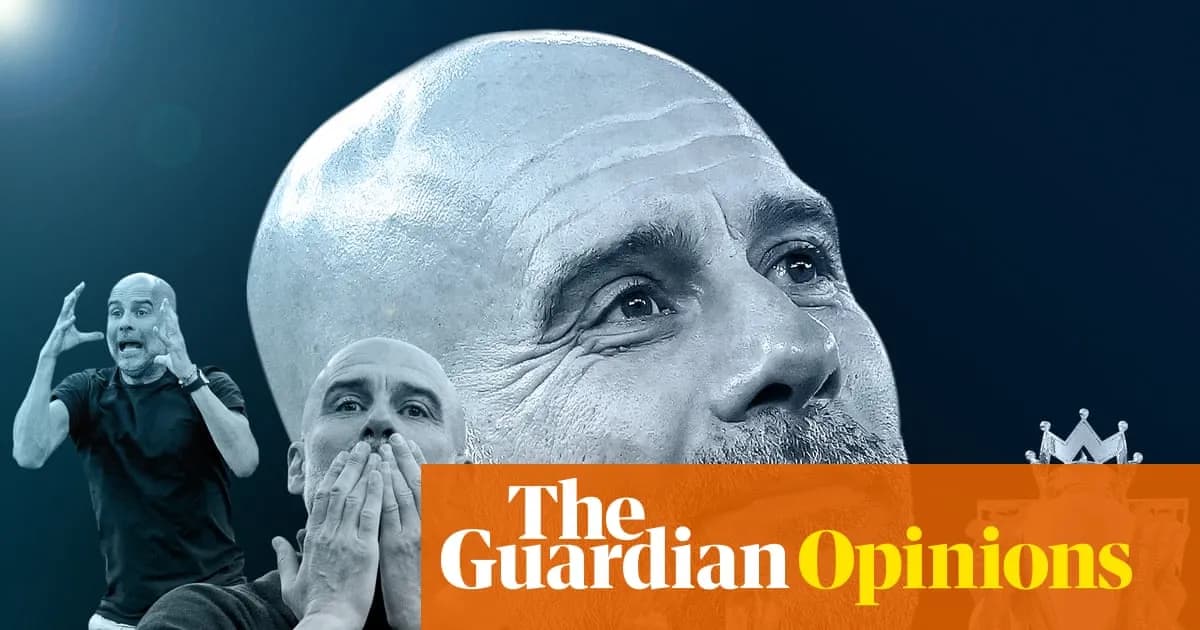
Pep Guardiola leaves Manchester City: the end of a golden era
After a decade of resounding success, Pep Guardiola is preparing to leave Manchester City. His legacy, marked by unprecedented dominance, nevertheless raises questions about the role of sport in geopolitical dynamics.
Pep Guardiola seems ready to end his adventure at Manchester City. According to information from The Guardian, the Catalan technician is not expected to honor the last year of his contract, which ends in 2025. The absence of formal denials from the club or the coach reinforces the likelihood of this departure, which would put an end to an era of unprecedented dominance in England.
This decision, if confirmed, would mean the end of a decade of intense dedication to the pursuit of victory. The prospect of a well-deserved rest, perhaps devoted to more philosophical or architectural reflections, looms for the coach who has revolutionized Manchester City's game and left an indelible mark on world football.
Although the club has not yet officially communicated on the subject, the signs point to Pep Guardiola's departure at the end of the season. The Guardian, citing internal sources, suggests that the decision has been made and that the last year of the contract will not be executed. No official announcement has been made yet, but the absence of strong denials suggests an imminent confirmation.
The period spent by Guardiola at the helm of Manchester City has been marked by a series of resounding successes. Under his leadership, the club has won numerous titles, establishing rare dominance on the national stage. This exceptional sporting success has, however, been scrutinized from a broader perspective, combining politics, influence, and massive investments, aspects that complicate the analysis of his legacy.
Pep Guardiola's departure represents much more than a simple change of coach for Manchester City. It symbolizes the end of a golden era, characterized by a polished style of play, formidable efficiency, and an impressive collection of trophies. The Spanish technician succeeded in instilling a philosophy that transcended results, making the club a global benchmark in terms of play and management.
Guardiola's legacy at Manchester City is inseparable from the investments made by its owners. The Guardian points out that his success is intrinsically linked to the club's power dynamics and global communication strategies. This political and geopolitical dimension adds a layer of complexity to the glorification of his sporting achievements, inviting reflection on the role of football in image and influence representation.
In the world of football, the unofficial announcement of Pep Guardiola's departure is causing a stir. Coaches, players, and observers unanimously recognize the Spaniard's revolutionary impact on the game and on Manchester City's performances. His ability to transform teams and win consistently is hailed as exceptional, placing him undoubtedly among the greatest in the history of the sport.
However, as The Guardian article points out, this recognition is accompanied by a critical look at the context in which these successes were built. Questions about funding, governance, and the use of sport as a soft power tool are inevitably raised, adding a dimension of debate to the celebration of his on-field achievements.
The Tactical Imprint of a Master
Pep Guardiola's influence on modern football is undeniable, and Manchester City has been its most successful laboratory. His ability to shape his team's play, to impose a strong identity based on possession, high pressing, and the constant search for numerical superiority in key areas has redefined tactical standards. He has adapted his principles to the players at his disposal while maintaining a philosophical coherence that has made his team recognizable among all others. Fluid systems, coordinated movements, and extraordinary collective intelligence have been the pillars of his success, transforming every match into a demonstration of mastery.
Beyond tactical formations, Guardiola has also excelled in managing individuals, transforming talented players into key components of a formidable collective. His approach to the game, often described as obsessive, has pushed his players to surpass themselves, leading them to a deep understanding of the demands of the highest level. This perpetual quest for perfection has made Manchester City a winning machine, capable of dominating its opponents over time.
A Complex Legacy Between Sporting Glory and Geopolitical Realities
The magnitude of Pep Guardiola's successes at Manchester City cannot be separated from the financial and geopolitical context in which the club operates. The Guardian article highlights how his achievements are part of a broader strategy of international influence, where football becomes a vector of influence and soft power for its owners. This dimension, often overshadowed by the enthusiasm of victories, raises fundamental questions about the nature of contemporary professional football.
Sporting success, however brilliant, is thus the result of considerable investments and a strategic vision that goes beyond the purely sporting framework. Guardiola's contribution is undeniable in optimizing these resources to achieve excellence on the field, but it is crucial to recognize that his tenure is part of a larger operation, where sporting performance is a key element of a global image and influence strategy.
The Successor's Challenge and Project Continuity
With Pep Guardiola's probable departure, Manchester City faces a major challenge: finding a successor capable of maintaining the level of excellence achieved and continuing the playing philosophy put in place. The choice of the next coach will be decisive for the club's future and the sustainability of its model. It will not only be about replacing a brilliant technician but about finding someone who can integrate into the club's culture and pursue its stated ambitions.
The transition promises to be complex, as Guardiola's shadow will be long. The club will have to navigate between the need for renewal and the desire to preserve what has been achieved. How Manchester City approaches this new era, both in sporting terms and in terms of communication, will be closely watched by the football world, eager to see how such a winning machine will manage the end of a cycle.
What's Next
With Pep Guardiola's probable departure, Manchester City will have to look to the future and find a successor capable of maintaining the level of excellence achieved. The search for a new coach promises to be a crucial issue for the club, which will have to define its new sporting strategy while managing the exceptional legacy left by its predecessor. How the club approaches this transition will be decisive for the rest of its history.
In Summary
Pep Guardiola's imminent departure from Manchester City, although not officially confirmed, marks the end of an era. His tenure has been synonymous with unprecedented sporting success, but The Guardian article invites a more nuanced analysis, highlighting the intertwining of his achievements with the club's political and financial stakes. Guardiola's tactical impact has revolutionized the game, but his complex legacy, blending sporting glory and geopolitical realities, leaves open questions about the role of modern football. The club is now preparing to take on the challenge of finding a successor worthy of this legend, in a context where project continuity will be paramount.