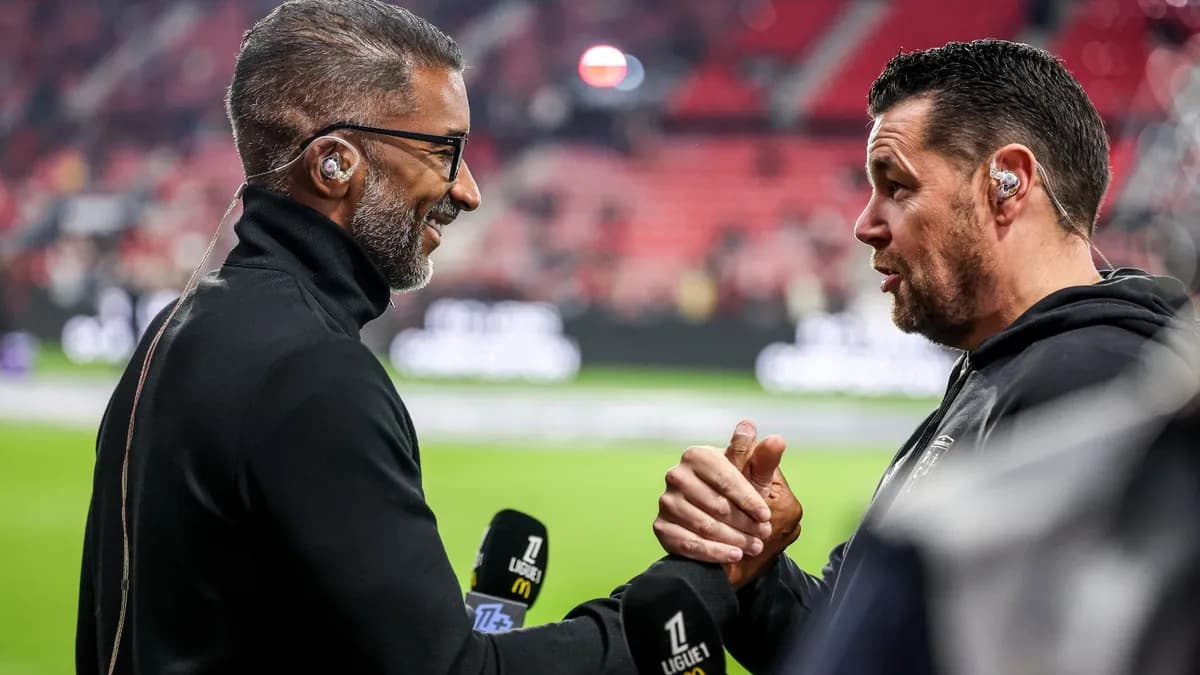
Pierre Sage Defends Habib Beye: Support from a Ligue 1 Coach to the Former OM Coach
Pierre Sage, best Ligue 1 coach, publicly supported Habib Beye during the UNFP awards. Former assistant to Beye at Red Star, Sage highlights his human qualities and tactical expertise.
During the UNFP awards ceremony, Pierre Sage, freshly awarded the best coach of the Ligue 1 season, spoke out to defend Habib Beye, the current coach of Olympique de Marseille. This stance comes at a time when Beye faces various criticisms regarding his management and tactical choices. Sage, who was Beye's assistant at Red Star, wanted to remind everyone of the human and professional value of his former colleague.
According to RMC Sport, Pierre Sage described Habib Beye as a "wonderful person and great coach," thus highlighting a mutual respect nurtured by close collaboration. This public defense is all the more striking as it comes from a coach praised for his remarkable performances in Ligue 1, notably with Lens.
The connection between Pierre Sage and Habib Beye is not recent. Their collaboration at Red Star allowed Sage to discover Beye's coaching methods and philosophy. This shared experience has clearly left a positive mark, as Sage describes Beye as a coach who is both humane and competent, capable of managing the pressures inherent to the highest level.
This professional relationship between two coaches who evolved in different contexts but share a common foundation of tactical and human values offers valuable insight into Beye's stature in French football. Sage, as the recipient of the best Ligue 1 coach award, thus lends significant credibility to Beye in the public debate.
The recognition of Pierre Sage, whose Lens team is excelling this season, gives particular weight to his support. Indeed, Sage has imposed his tactical and managerial vision to elevate his club to the top of the standings, proof of his recognized expertise in the elite of French football. His testimony about Beye thus goes beyond simple professional friendship to become a serious analysis of the qualities of an active coach.
In a championship as competitive as Ligue 1, where coaches are under constant pressure, receiving such support from an experienced peer is a strong indicator of the esteem Beye enjoys. It invites a reassessment of some hasty judgments made about his trajectory at OM.
Habib Beye, at the helm of Olympique de Marseille, navigates a demanding environment where results and the management of a squad rich in talent are intensely scrutinized. The context of Ligue 1 requires coaches to constantly adapt to sporting and media uncertainties.
Pierre Sage's support reminds us that behind the results, there is a crucial human dimension in the role of a coach. The shared experience at Red Star, a historic club in French football, thus highlights the complexity and richness of the profession, often reduced to numerical results in the media.
Towards a New Perspective on Coaching at OM?
As Ligue 1 continues to intensify, the analysis of a coach's performance can no longer be limited to immediate results. Pierre Sage's testimony opens a path for reflection on recognizing the intrinsic qualities of coaches, especially in clubs like Marseille, where media pressure is heightened.
Habib Beye, supported by a UNFP trophy winner, now benefits from backing that could positively influence the public and internal perception of his sporting project. This dynamic could prove decisive for the stability and progress of OM in the championship.
Historical Context and Challenges of the Marseille Club in Ligue 1
Olympique de Marseille, a club with a rich historical background, competes in a French championship where competition continues to grow. Since its foundation, OM has always represented a pillar of French football, with strong expectations from its supporters and management. Ligue 1, in constant evolution, presents coaches with renewed tactical challenges, notably with the arrival of new generations of players and technological development in match preparation.
In this context, managing a squad as large as Marseille's requires precise mastery of human and technical aspects. The club is also under close scrutiny from the media and its fans, which amplifies the pressure on the technical staff. Habib Beye must therefore combine sporting ambition and expectation management in an environment where every decision is deeply analyzed.
Tactical Challenges at the Heart of Beye's Strategy
On the tactical level, Habib Beye has had to face complex situations, notably by adapting his game plan to the strengths of his squad and the opponents encountered. Ligue 1, characterized by its diversity of styles and strategies, demands great flexibility from coaches. Beye has demonstrated his ability to adjust his plans, sometimes at the cost of criticism, but always with the goal of getting the best out of his players.
This tactical approach, combined with attentive human management, is an integral part of the recognition Pierre Sage grants him. It also highlights the importance for a coach not to limit himself to immediate results but to build a coherent long-term project, integrating both the collective and individual dimensions of the players.
Perspectives for OM and French Football
Pierre Sage's public support opens interesting perspectives for Habib Beye and Olympique de Marseille. In an increasingly competitive Ligue 1, marked by major financial and sporting stakes, the stability of a technical project is often a key to success. Recognition by an experienced peer can foster a climate of trust around the Marseille coach, essential for moving forward serenely.
Moreover, this dynamic could encourage a better understanding of the coaching role in French football in general. By valuing human and tactical qualities beyond raw results, Ligue 1 could see the emergence of a new model of support for coaches, more respectful of the complexity of the profession and the specific contexts of each club.
In Summary
Pierre Sage's speech in favor of Habib Beye during the UNFP awards highlights valuable support in a context where the OM coach faces criticism. Their shared past at Red Star and Sage's stature in French football give weight to this defense, inviting a more nuanced reading of Beye's career and qualities. Between tactical challenges, human management, and media pressure, coaching at Marseille fits into a complex dynamic where peer recognition can play a decisive role for the future of the club and French football.