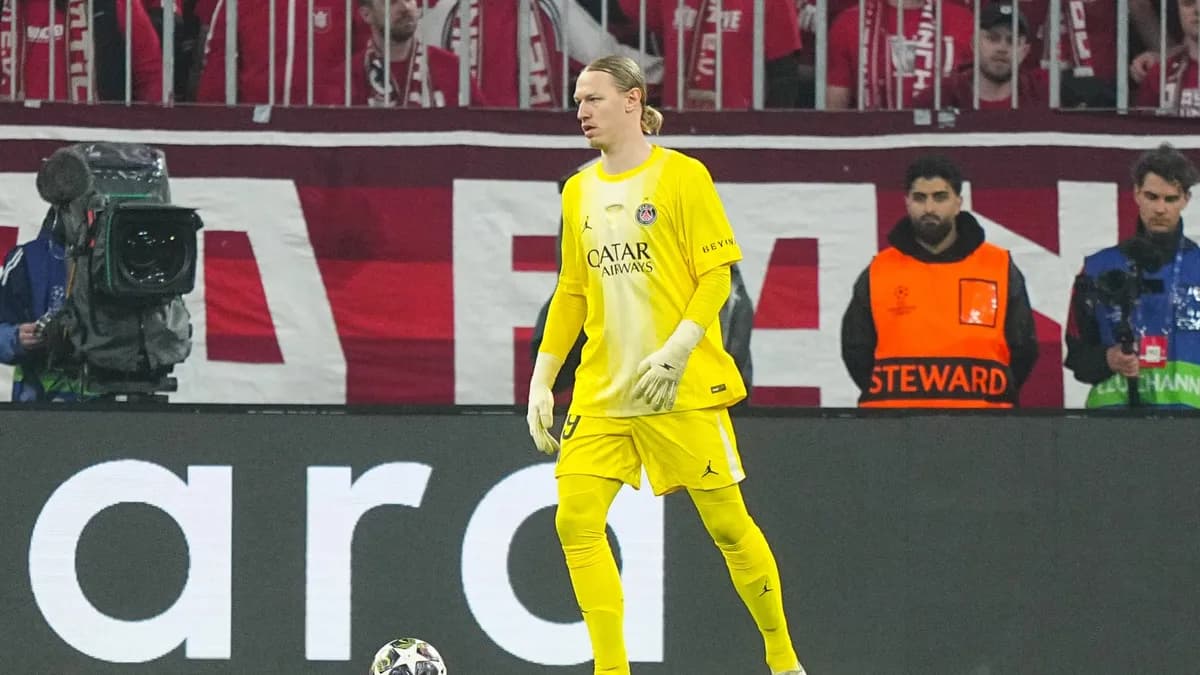
PSG: Luis Enrique's Tactic on Safonov's Throw-ins Against Bayern in 2026
During the Champions League semi-final second leg against Bayern Munich, Luis Enrique imposed a precise strategy on his goalkeeper Matvey Safonov for his throw-ins, aiming to counter the German pressing. This technical approach played a key role in PSG's qualification.
During the Champions League semi-final second leg against Bayern Munich, Parisian goalkeeper Matvey Safonov adopted a particular technique for his throw-ins, limiting the distance to a maximum of 10 meters from the line. Contrary to a series of mistakes, this strategy was an explicit request from coach Luis Enrique, as revealed by RMC Sport.
This instruction aims to adapt to Bayern's high and intense pressing style, forcing the Parisian team to react quickly and structure its defensive block in a coordinated manner. Luis Enrique thus asked Safonov not to seek to gain distance with his throw-ins, but rather to ensure a controlled and quick restart.
A block that immediately pushes up: the intended effect
By limiting the distance of the throw-ins and encouraging the team to push up immediately, PSG sought to break Bayern's pressing intensity. This tactic notably helps reduce dangerous ball losses in sensitive areas of the pitch.
Practically, after each throw-in, the Parisian block advances quickly to recover the ball and prevent Bayern from setting up their offensive play. This method, orchestrated by Luis Enrique, contributed to PSG's defensive solidity during this crucial match.
According to available data, this organization allowed PSG to better manage possession and control the match tempo, a key factor in a confrontation of this level.
An adaptation to Bayern Munich's playing style
Bayern is known for its aggressive pressing and fast transitional play. Luis Enrique, aware of this threat, therefore designed this strategy to minimize risks during set pieces, notably throw-ins, which are often prone to ball losses.
By limiting the length of the throw-ins and quickly mobilizing the block, PSG aimed to prevent Bayern from exploiting spaces left behind the defense. This approach is a clear example of tactical adaptation against a high-level opponent.
This instruction highlights Luis Enrique's ability to customize his players' roles according to the opponent and match context.
The key role of Matvey Safonov in implementing the tactic
Starting goalkeeper for this semi-final second leg, Matvey Safonov had to adjust his game by precisely following his coach's instructions. His ability to perform short and precise throw-ins while remaining calm under pressure was decisive.
Safonov thus demonstrated great technical versatility and advanced tactical understanding, essential elements for competing at the highest European level.
Implications for goalkeeper preparation in the Champions League
This tactical approach by Luis Enrique illustrates a growing trend to integrate goalkeepers into complex game schemes, where every restart is designed to respond to the opponent's pressing.
Goalkeepers must now master several types of clearances adapted to different situations, strengthening their role beyond simply protecting the goal.
The historical context of PSG in the Champions League and the tactical challenge
The Paris Saint-Germain, driven by its European ambitions, has continuously sought innovative tactical solutions to reach the next level in the Champions League. Since its arrival in European elite football in 2011, the club has regularly faced continental giants like Bayern Munich, with varying fortunes. Each confrontation has highlighted the importance of rigorous defensive organization, especially against relentless high pressing. In this context, Luis Enrique's decision to adopt such a specific strategy for throw-ins shows PSG's determination to master every aspect of the game to avoid costly mistakes and impose themselves against tactically demanding opponents.
This approach fits into a broader logic where mastering restart phases has become a determining factor in the outcomes of high-intensity matches. Indeed, in a competition as tight as the Champions League, every detail counts and can make the difference between qualification and elimination.
A direct impact on the standings and future prospects
PSG's tactical success against Bayern Munich has major implications for the club and its trajectory in Ligue 1 as well as in Europe. By effectively managing Bayern's pressing in this crucial match, PSG strengthened its collective confidence and demonstrated its ability to adapt to the most demanding challenges. This tactical progression can translate into positive momentum in the national championship, where the club aims to consolidate its position at the top of the standings.
Beyond immediate results, this innovation shows that PSG is ready to evolve and integrate modern concepts, which could influence the preparation of future European matches. It also opens the way to a deeper reflection on the goalkeeper's role in game strategies, an aspect that could become a key asset in the club's quest for the coveted continental trophy.
Tactical challenges against modern pressing and football evolution
The strategy implemented by Luis Enrique against Bayern illustrates a general trend in modern football where high pressing and rapid execution of transition phases often dictate the rhythm of matches. By limiting the range of throw-ins and encouraging the block to push up quickly, PSG aligns with this tactical movement aimed at maintaining ball control while minimizing risks related to ball losses.
This approach requires intense collective work, fluid communication between players, and strict tactical discipline. It also highlights the evolution of the goalkeeper's role, who is no longer confined to a purely defensive role but becomes a true player in the build-up. This transformation impacts team preparation and redefines the selection and training criteria for goalkeepers at the highest level.
In summary
Luis Enrique's instruction to Safonov for these throw-ins reveals significant tactical sophistication in modern football, especially during high-intensity matches like a Champions League semi-final. This strategy allowed PSG to better control their direct opponent and avoid costly ball losses.
However, it requires perfect coordination between the goalkeeper and the defensive block, as well as high tactical discipline, under penalty of the system becoming unbalanced. The success encountered against Bayern highlights the effectiveness of this method when well executed.
In the future, this type of optimization of restart phases could become widespread, transforming the goalkeeper's role into a true conductor of game construction.