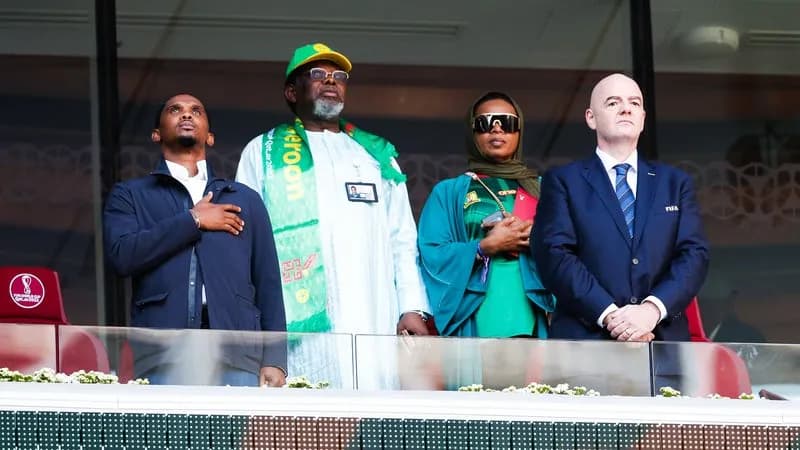
Samuel Eto'o defends Infantino and revives World Cup sale
In an interview with CNN, Samuel Eto'o comes to the defense of Gianni Infantino, criticized for his controversial plan to sell the World Cup. The FECAFOOT president wants FIFA to reopen this matter, reigniting the debate on the commercialization of the organization.
The debate over FIFA's governance is taking a new turn. While Gianni Infantino has faced growing criticism for several weeks, Samuel Eto'o, president of the Cameroonian Football Federation (FECAFOOT), has chosen to come to the leader's rescue. In an interview with CNN, the former FC Barcelona and Inter Milan striker took a stand in favor of the president of the world governing body, while reviving the idea of selling shares in the World Cup.
What we know: Eto'o's position and the controversial plan
According to RMC Sport, Samuel Eto'o said that Infantino "has done nothing wrong," offering unwavering support to the FIFA president. This statement comes in a tense context, marked by contested decisions at the helm of world football. The "World Cup sale" project mentioned by the FECAFOOT president refers to a possible commercialization of the rights to the flagship competition, an idea that had sparked strong reactions within the football world.
Eto'o did not just defend Infantino. He also called for reopening this matter, suggesting that FIFA should explore this avenue to strengthen its finances. This position, reported by RMC Sport, marks a risk for the former Cameroonian international, who aligns himself with a sensitive political line within the governing body.
The context: a project that has divided for several years
The idea of selling shares in the World Cup is not new. For several years, FIFA has sought to diversify its revenue sources to cope with the rising costs of organizing competitions and developing football worldwide. This project, supported by some leaders, aims to attract private investors in exchange for a share of the profits generated by the World Cup. However, this approach raises many ethical and financial questions.
Opponents of this project fear that private interests will take control of a competition that belongs to world football. They believe it could compromise sporting fairness and the independence of the governing body. Moreover, selling shares could set a dangerous precedent, encouraging other competitions to follow the same path. Despite these concerns, some see it as an opportunity to fund development programs in regions where sports infrastructure is still insufficient.
Why this matters for FIFA and world football
Samuel Eto'o's media appearance comes at a pivotal time for FIFA. If the project to sell shares in the World Cup were to materialize, it could transform the economic model of international football. By defending this idea, Eto'o provides significant support to Infantino, whose management is increasingly contested by some federations and observers.
For FECAFOOT, this stance strengthens its influence within African and global bodies. Samuel Eto'o, elected head of the Cameroonian federation in 2021, seeks to consolidate his role on the international stage. By defending Infantino, he gains favor with FIFA, which could benefit Cameroonian football in the coming years. Cameroon, which already hosted the Africa Cup of Nations in 2021, could thus obtain additional support for its future sporting projects.
Behind the scenes: a matter revived by Eto'o
Samuel Eto'o's interview with CNN did not go unnoticed. According to RMC Sport, the FECAFOOT president explicitly asked Infantino to reopen the matter of selling shares in the World Cup. This request comes as FIFA seeks new revenue sources to fund its development programs, particularly in Africa and Asia.
Reactions were quick. While some praise Eto'o's courage, others worry about the consequences of such commercialization. Selling the World Cup could indeed open the door to private investors, to the detriment of national federations and fans. The debate is far from settled, but Eto'o's statement has the merit of putting the subject back on the table.
Sporting and financial implications
On the sporting front, such a sale could alter the distribution of revenues among federations, with direct consequences for the funding of national teams and clubs. Emerging countries, which heavily depend on FIFA's aid, could be particularly affected. A partial privatization of the World Cup could also influence decisions regarding the awarding of competitions, favoring the most profitable countries over sporting considerations.
On the financial front, the amounts at stake are colossal. The World Cup generates billions of dollars in revenue through broadcasting rights, marketing, and sponsors. Selling a share of these revenues could bring in considerable sums in the short term, but in the long term, it could reduce FIFA's room for maneuver. Moreover, private investors would likely demand a quick return on investment, which could lead to higher ticket prices and increased commodification of the event.
Obstacles and next steps for Infantino
Despite Samuel Eto'o's support, Gianni Infantino will need to convince FIFA's 211 member federations of the project's relevance. The coming weeks will be decisive, with the FIFA Congress scheduled for 2027, where this issue could be debated. In the meantime, the FIFA president can count on FECAFOOT's backing but will face growing opposition.
For Samuel Eto'o, this stance could have repercussions on his own mandate. Some members of Cameroonian football might view this closeness to Infantino negatively, especially with federal elections expected in the coming years. In any case, the debate on the World Cup sale has been revived, and the next statements from those involved will need to be closely monitored.
A support that raises questions
Samuel Eto'o's stance in favor of Gianni Infantino raises questions about the FECAFOOT president's motivations. Some see it as a political strategy to strengthen his influence within FIFA, while others believe it is a personal conviction. In any case, this media appearance has the merit of bringing to the forefront a crucial debate for the future of world football.
As criticism pours in from all sides, Eto'o's support could be a strong signal for other African federations. Indeed, if several voices rise to defend Infantino, it could change the game in the next elections. African football, which represents a significant share of FIFA's votes, could play a key role in validating this controversial project.
Conclusion: a debate far from over
Samuel Eto'o's statement revives a debate that is likely to mark the coming years of world football. Between support and opposition, the World Cup sale is shaping up to be one of the most sensitive issues in FIFA's governance. For now, information not yet confirmed at this stage, no decision has been made, but discussions are in full swing. We will have to wait for the next FIFA Congress to see if this idea will be officially put on the table. In the meantime, world football stakeholders are holding their breath.