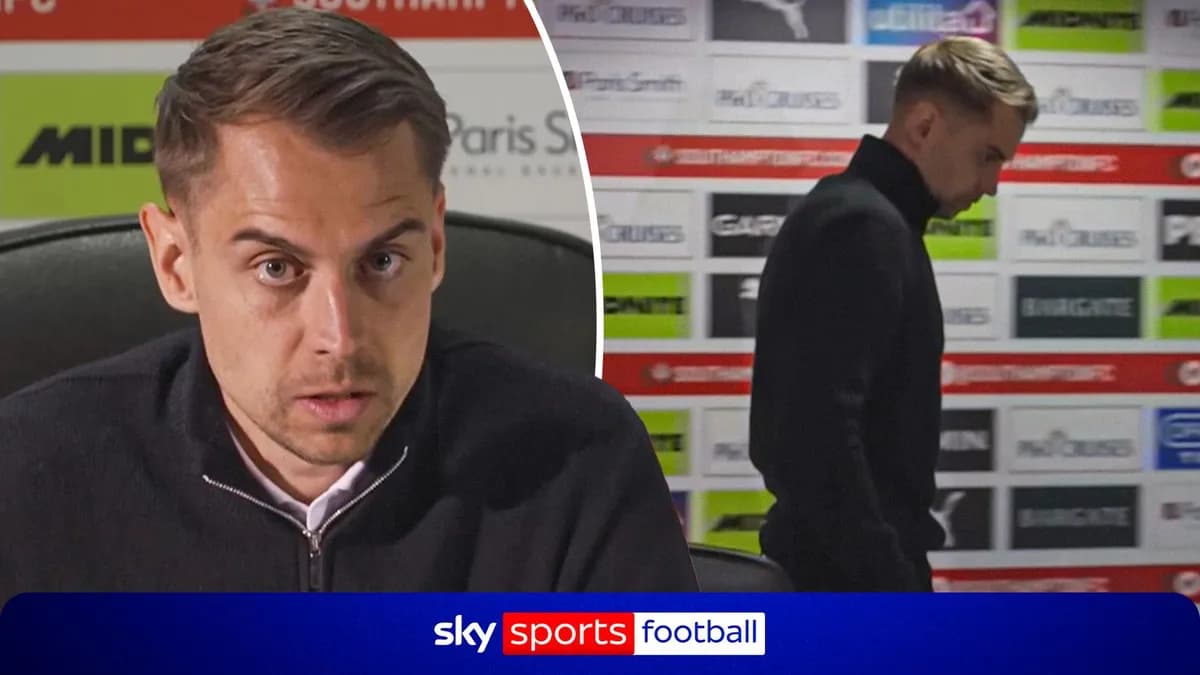
Tonda Eckert prematurely leaves his press conference after a question about the play-offs 'spygate'
Southampton manager Tonda Eckert left a press conference following a question labeling him a "cheater" in the 'spygate' affair related to the play-off match against Middlesbrough. This episode highlights the growing tension surrounding this controversy.
A press conference interrupted by a thorny question
During a recent press conference, Tonda Eckert, the manager of Southampton, left prematurely after being questioned about an accusation of cheating. This question referred to the so-called "spygate" controversy surrounding the play-off match between Southampton and Middlesbrough. According to Sky Sports, this interruption is the second of its kind for Eckert in this context, revealing palpable tension around the subject.
This "spygate" affair concerns allegations that Southampton attempted to gain an unfair advantage by spying on their opponent's preparations. The exact nature of the accusations remains, at this stage, officially unconfirmed, but the controversy has already widely fueled media and sports debates.
The weight of the accusation on the club's dynamics
This controversy comes at a crucial moment in the season, as Southampton prepares to play decisive matches for access to the Premier League via the play-offs. The media and sporting pressure is now coupled with a moral and ethical dimension, exacerbated by the direct questioning of the manager's integrity.
The fact that Tonda Eckert left the conference rather than responding could be interpreted as a refusal to feed the controversy or as a reaction to an accusation deemed unfair. In any case, this situation could affect the team's focus and cohesion at a key moment in the competition.
According to available data, Southampton is in a delicate position, and this affair only adds a layer of uncertainty regarding the rest of the season and the club's image.
Implications for the Premier League and managing the controversy
"Spygate" is not an unprecedented phenomenon in football, but the way it is managed by clubs and sporting authorities can have lasting repercussions on fans' trust and the fairness of the competition. The Premier League, which regulates the play-offs, is closely monitoring these allegations to preserve the championship's integrity.
The responses provided by Southampton, through its technical staff and management, will be scrutinized in the coming days. Clear and transparent communication will be necessary to ease tensions and ensure the competition proceeds according to the rules.
Towards an expected resolution and a future under pressure
At present, the outcome of this affair remains uncertain. The official investigation, if conducted, will need to establish the facts and determine if sanctions are justified. Meanwhile, Southampton must manage the media and sporting impact of this controversy to avoid compromising its ambitions in the play-offs.
This context highlights the growing importance of ethics and transparency issues in professional football, where every detail can now be subject to rigorous scrutiny, amplified by the media and social networks.
For the club, the priority remains performance on the pitch, but managing this affair could have a lasting influence on its image and relationship with its supporters.
A heavy historical context for Southampton
Southampton, a historic English football club, has always oscillated between high-level ambitions and challenges imposed by the fierce competition of the Championship and the Premier League. Over the years, the club has built a strong identity focused on technical play and prudent talent management. However, periods of transition and the stakes related to promotion to the Premier League have often put pressure on the leaders and technical staff.
This pressure is all the more exacerbated in the current play-offs context, where every decision, every tactical detail, and every controversy can weigh heavily. Southampton's reputation, which has long relied on a policy of training and transparency, is today tested by this "spygate" affair, which could leave a lasting mark in the club's recent history.
In this climate, internal crisis management and renewed unity around the sporting project will be determining factors for the rest of the season and for maintaining supporters' trust, who are often very attached to the club's integrity.
Tactical and strategic stakes approaching the play-offs
From a sporting perspective, preparing for the play-off matches is a delicate exercise that requires maximum optimization of human resources and particular attention to game strategy. The cheating accusation, especially in the context of "spygate," raises the question of fairness in teams' tactical preparation.
The play-offs, known for their intensity and unpredictability, demand a perfect balance between defensive rigor and offensive creativity. In this context, any suspicion of spying can cast doubt on the legitimacy of tactical choices and fair play, two essential pillars in the competition.
For Southampton, it is therefore not only about managing media pressure but also maintaining cohesion and internal trust to approach these crucial matches with serenity. The staff's ability to refocus attention on the game plan will be a key factor to prevent the controversy from disrupting sporting performance.
Perspectives and potential impact on the final standings
As Southampton is engaged in an intense fight to access the Premier League via the play-offs, this controversy arises at a sensitive moment where the slightest distraction can have major consequences on the final standings and the club's ambitions. Managing this crisis could thus influence not only the team's current dynamics but also its short- and medium-term future.
The outcome of this affair could also have repercussions on the confidence of partners, sponsors, and supporters, essential elements to support the club in its future projects. A quick and transparent resolution is therefore crucial to limit damage and regain control of the situation.
Finally, this situation reminds us that the pressure exerted during competitions as crucial as the play-offs is not limited to the pitch alone but also encompasses media and ethical stakes, which increasingly weigh heavily in managing a professional club.
In summary
Tonda Eckert, Southampton manager, interrupted a press conference after a delicate question related to the "spygate" affair surrounding the club before the play-off match against Middlesbrough. This controversy casts a shadow over the team's preparation and the club's image at a crucial moment in the season.
Managing this crisis, in an already heavy historical context for Southampton, raises major tactical, ethical, and strategic issues. The reaction of the club and sporting authorities will be decisive for the rest of the competition and for preserving football's integrity.
As decisive matches approach, the priority remains performance on the pitch, but transparency and communication will be key to easing tensions and maintaining the trust of supporters and partners. The outcome of this affair could have a lasting influence on the club's future and the championship's dynamics.