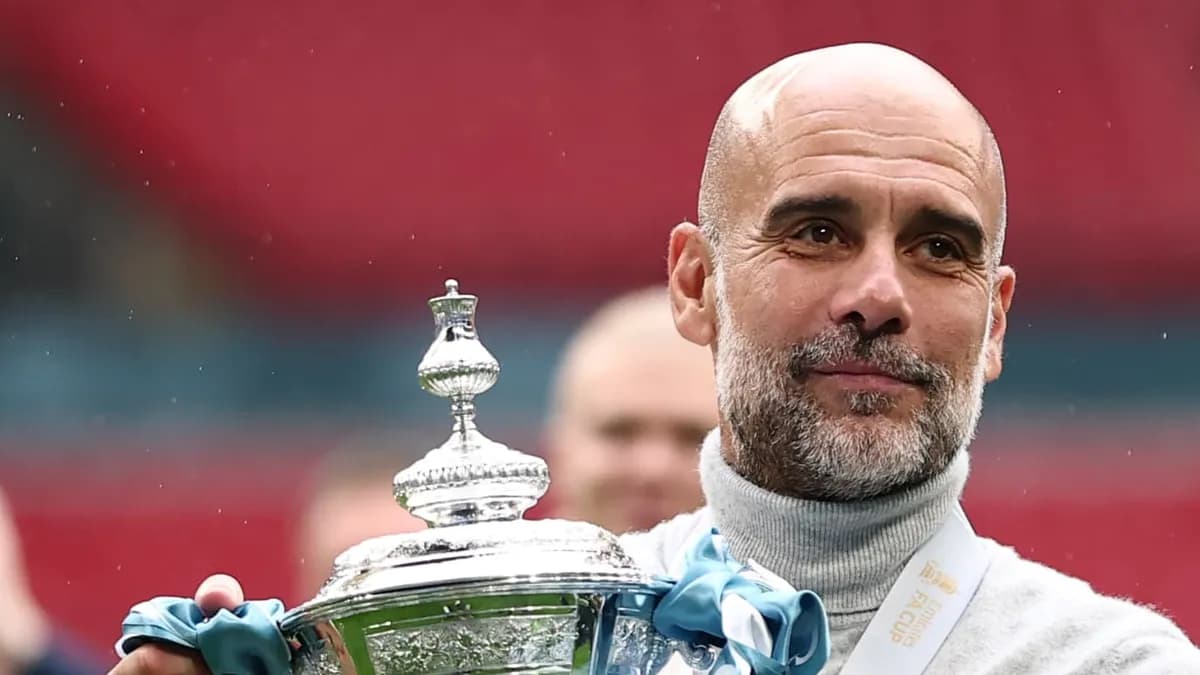
Top 5 Reasons Explaining Pep Guardiola's Departure from Manchester City in the Premier League
Pep Guardiola leaves Manchester City after an exceptional era marked by twenty trophies. A look back at the five main factors that shaped his journey and motivated this historic decision in the Premier League.
After nearly ten years at the helm of Manchester City, Pep Guardiola announced his departure at the end of the season. Arriving in July 2016, the Spanish coach has deeply marked the Premier League, establishing himself as one of the greatest managers of his era. This decision ends an unprecedented period of dominance for the Manchester club.
This ranking reviews the five major reasons explaining this turning point in English football. Between sporting successes, personal evolution, media pressure, and future ambitions, we analyze the key factors that led Guardiola to end this fruitful collaboration.
Since his arrival in July 2016, Pep Guardiola has compiled an impressive record with Manchester City, totaling twenty trophies according to RMC Sport. This record testifies not only to his tactical mastery but also to his ability to maintain a high level of performance over several seasons. These successes have consolidated City's place among the European heavyweights and have strengthened Guardiola's stature as one of the best active coaches.
However, this exceptional success also brings a form of exhaustion, both physical and mental, for the coach. The constant conquest of titles requires a permanent demand, which may have contributed to his decision to leave the club at the end of the season.
In a context where the average tenure of a coach is often short, Guardiola spent nearly ten years at Manchester City, which is a remarkable longevity in professional football. This stability has favored the construction of a long-term project, with a clearly defined playing philosophy and targeted recruitment.
This longevity also reflects a strong relationship between the manager and the club's management. Nevertheless, it inevitably leads to a form of wear, especially as football evolves rapidly, and tactical and human challenges constantly renew. Guardiola's departure thus marks the end of an exceptionally stable period.
Pep Guardiola's time at Manchester City has profoundly transformed the Premier League, both tactically and in the media. His style of play based on possession, high pressing, and offensive creativity has inspired many coaches and raised the overall level of the English championship.
Beyond the sporting aspect, Guardiola has helped strengthen the Premier League's international appeal, attracting the best players and increasing the media exposure of the club and the league. His departure therefore represents a turning point for the league, which loses one of its emblematic figures.
2. The end of a personal and professional cycle
After reaching heights with Manchester City, Guardiola seems to have decided to close an exceptional chapter. According to information from RMC Sport, the Spanish coach likely wishes to take on new challenges elsewhere after a decade rich in success.
This decision can also be explained by a desire to renew himself, to find a different motivation, or to devote himself to other projects. The end of this era thus illustrates a natural evolution in the career of a coach of his caliber, who constantly seeks to surpass himself.
1. A lasting legacy and an uncertain future
Pep Guardiola's departure from Manchester City marks the end of an era marked by twenty trophies and undisputed dominance in the Premier League, according to RMC Sport. His legacy is immense, both on a sporting and cultural level, and the club will now have to cope with this major absence.
This transition raises many questions about the club's future and about the successor who will have to perpetuate this dynamic. For Guardiola, the future remains to be defined, information not confirmed at this stage. This departure thus opens a new chapter in the history of English football, full of uncertainties but also opportunities.
Historical context of the club and evolution in the Premier League
Manchester City, founded in 1880, was long considered a historic club but without the consistency of England's top teams. It was only in the early 2010s, with the arrival of new investors, that the club began a major transformation. Pep Guardiola's arrival in 2016 truly catalyzed this metamorphosis, placing City in a dynamic of local and European dominance. The Premier League, already very competitive, saw the emergence of a new giant, capable of competing with the best teams on the continent.
This period also coincided with a rise in financial and media stakes in the English championship, where each season is scrutinized by millions of fans worldwide. Guardiola managed to inscribe Manchester City in this new era, combining sporting excellence and international influence.
Tactical challenges and evolution of the game under Guardiola
On the tactical level, Guardiola revolutionized the way Manchester City approaches matches. His obsession with ball possession, intense pressing, and positional play forced his opponents to rethink their strategy. This approach not only allowed domination of the Premier League but also influenced all the clubs in the competition, which had to adapt to this demanding style.
Guardiola's ability to constantly innovate, to adjust his schemes based on players and situations, was a key element of his success. It also helped raise the technical and tactical level of the championship, making the Premier League a global reference for the intensity and quality of football offered.
Perspectives for Manchester City and the Premier League after Guardiola
Pep Guardiola's departure leaves a considerable void at Manchester City, which must now consider its future without its emblematic strategist. The question of the successor is crucial, as he will not only have to maintain the high standards set by Guardiola but also inject new dynamics to continue competing at the highest level.
For the Premier League, this transition marks the end of a period dominated by a charismatic and innovative coach. This could open the way for a rebalancing of forces, with other clubs seeking to take advantage of this change to establish themselves. The uncertainty surrounding the coming seasons adds an exciting dimension to the evolution of English football.
In summary
In summary, Pep Guardiola's departure from Manchester City is explained by a combination of elements: an exceptional record, rare longevity, a considerable impact on the Premier League, the end of a personal cycle, and a lasting legacy. This choice marks the end of an era and the beginning of a major transition for the club and the English championship.
According to information relayed by RMC Sport, this historic decision redraws the contours of British football and foreshadows many challenges for all stakeholders involved.