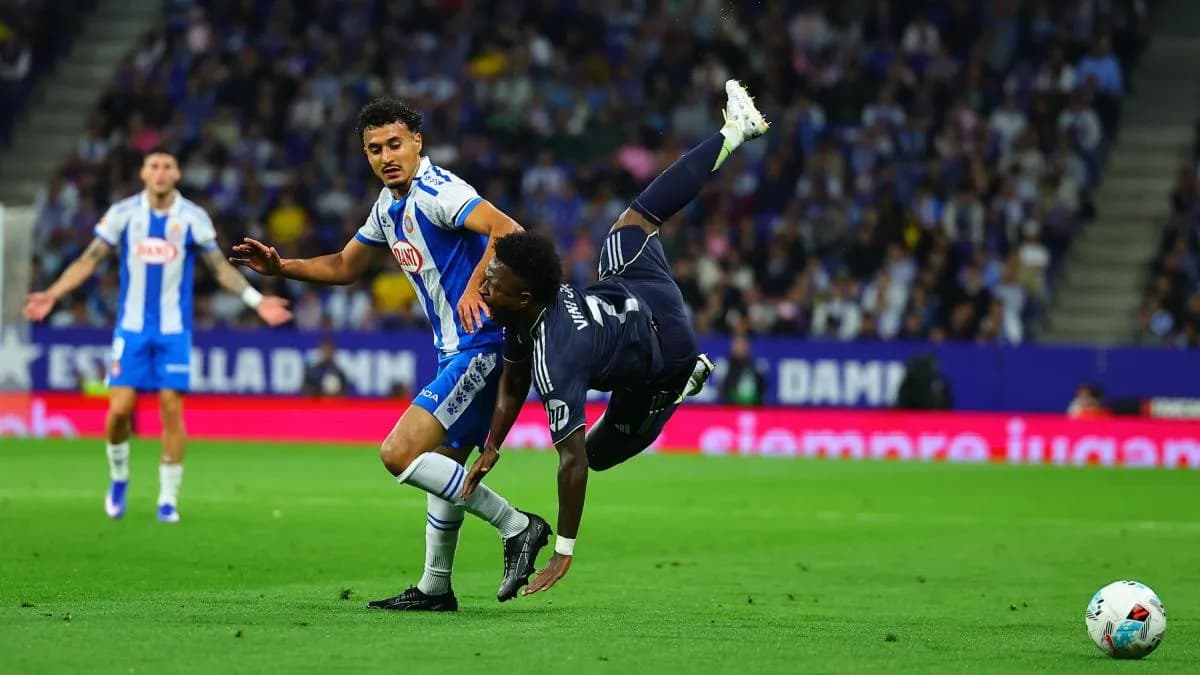
VAR in La Liga 2026: When Omar El Hilali’s Direct Red Card Against Vinicius Was Downgraded to Yellow
During the Espanyol-Real Madrid match, a rare VAR intervention led to the cancellation of a direct red card shown to Omar El Hilali for a foul on Vinicius. Referee Jesús Gil Manzano ultimately opted for a yellow card after video consultation, illustrating the evolving use of VAR in La Liga.
A Crucial Refereeing Decision Reviewed Thanks to VAR on Matchday 34 of La Liga
On matchday 34 of La Liga, the game between Espanyol and Real Madrid was marked by a decisive refereeing sequence involving the young player Omar El Hilali. Initially shown a direct red card in the 24th minute for a foul deemed severe on Vinicius, the Madrid attacker, El Hilali ultimately received only a yellow card following a VAR intervention. This revision, detailed by Mundo Deportivo, highlights the growing importance of video technology in regulating refereeing decisions in the Spanish championship.
The international match referee, Jesús Gil Manzano, had first sanctioned El Hilali with a direct sending-off following a forceful challenge on Vinicius. However, VAR official Jorge Figueroa Vázquez quickly advised Gil Manzano to "come and watch the action to consider the possible non-red card," which led to an in-depth review via the pitchside video monitor. After review, the red card was downgraded to yellow, thus imposing a less severe but still justified sanction.
What This Intervention Reveals About the Evolution of VAR in La Liga
This sequence is emblematic of how VAR is used to avoid major sporting injustices. The Spanish league, facing criticism over sometimes abrupt decisions, appears to favor a more nuanced interpretation of violent fouls. The El Hilali-Vinicius case shows that VAR is no longer just a tool for confirmation or cancellation but a system encouraging the referee to reassess the severity of an action.
Concretely, this downgrade has a direct impact on the match dynamics and player management. A direct red card would have excluded El Hilali for the remainder of the match, potentially altering the outcome of Real Madrid’s away game. By opting for a yellow card, the referee maintained balance on the pitch while still sanctioning a foul initially judged too harshly.
Compared to other VAR interventions in La Liga this season, this decision is the only one requiring a review on the 34th matchday according to available data. This underlines increased caution and a desire to ensure finer sporting justice.
The Technical Process Behind the Decision
VAR in La Liga operates from a control room called the VOR (Video Operations Room), where video referees analyze controversial actions in real time. Jorge Figueroa Vázquez, as the VAR operator, played a key role in assessing the severity of El Hilali’s foul and recommending that Jesús Gil Manzano review the incident on the monitor.
This human-machine interaction is essential: VAR does not decide alone but assists the central referee by providing clearer images and multiple slow-motion replays. Direct voice communication allows for quick and precise exchanges, ensuring the final decision is made with the maximum information available.
The downgrade from red to yellow card is based on a detailed analysis of criteria such as intent, danger, and impact of the foul, which are scrutinized by the VAR team before recommending modification of the initial sanction.
Who Benefits from This System and What Limitations Remain?
Players, teams, and fans benefit from fairer refereeing less prone to obvious errors. For El Hilali, this means the possibility to continue the match without immediate suspension, which is crucial in a tight competition context.
However, reliance on VAR also raises questions about game fluidity and the referee’s authority on the pitch. The time spent on video review can interrupt the rhythm, and subjectivity remains despite the technology. The decision here, although justified, could still spark debate depending on observers’ interpretations.
Implications for La Liga and Modern Football
This intervention demonstrates that La Liga continues to adapt to the demands of modern football by integrating technology to improve refereeing quality. The revision of El Hilali’s red card highlights the desire to avoid disproportionate sanctions that can distort the course of a match and influence the standings.
In a championship where every point counts, especially approaching the final phases, refereeing accuracy is a major issue. Using VAR as a moderation tool rather than strict sanctioning is a trend that could grow in coming seasons, impacting how violent actions are judged.
Final Analysis
The Espanyol-Real Madrid match scene perfectly illustrates the benefits and challenges of VAR in La Liga. The intervention by Jorge Figueroa Vázquez and the decision by Jesús Gil Manzano prevented a probably excessive sending-off, thus preserving sporting balance. This sequence confirms that well-used VAR is a lever for more nuanced sporting justice adapted to contemporary football’s demands.
For the tech-savvy public, this decision is a case study in the successful integration of video-assisted intelligence in a sport undergoing digital transformation, where refereeing now combines human judgment with advanced technological support.