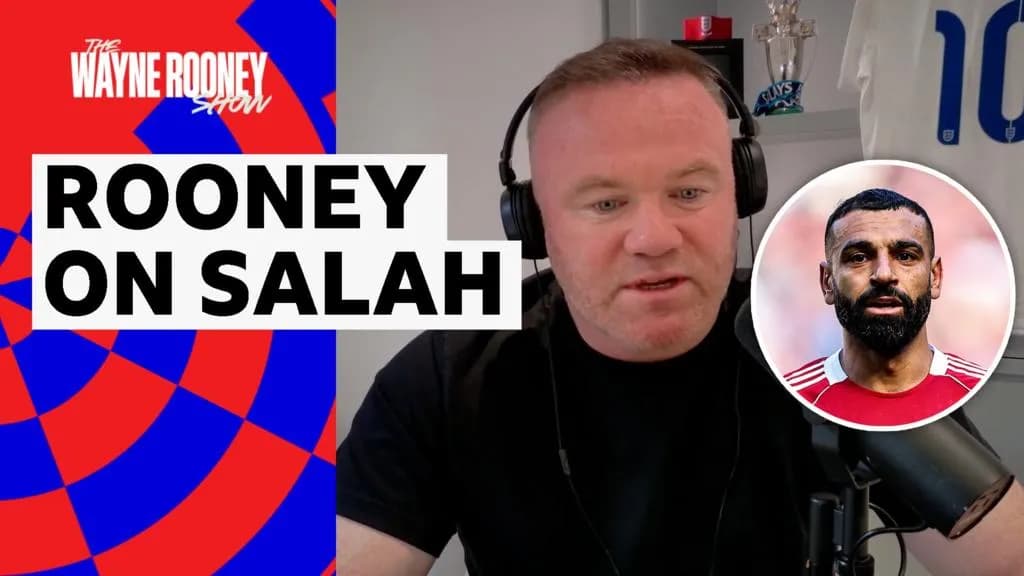
Wayne Rooney Criticizes Mohamed Salah After His Post on Liverpool's Style Ahead of the Premier League
Wayne Rooney strongly reacted to Mohamed Salah's message on social media, where the forward questioned Liverpool's style of play. Rooney states he would not put Salah "near the stadium" for the last Premier League match.
An Unexpected Controversy Between Rooney and Salah Over Liverpool's Style
In a statement relayed by BBC Sport Football, Wayne Rooney strongly criticized Mohamed Salah following a post by the Egyptian player on social media. Salah had expressed doubts about Liverpool's current style of play, which triggered a sharp reaction from the former England international. According to Rooney, he would not put Mohamed Salah "near the stadium" for Liverpool's last Premier League match, showing a deep disagreement about the player's attitude towards his club.
This statement comes as Liverpool prepares to play a key league match, in a context where team cohesion is essential to achieve its goals. Rooney's direct criticism highlights potential tensions between the expectations of former players and the current behavior of the club's stars.
A Debate on Playing Style and the Image of Star Players
Salah's intervention on his own style of play was perceived as an implicit questioning of Liverpool's tactical choices, a club known for its intense pressing and fast play. This type of public comment is unusual for a player of his caliber and can destabilize the internal atmosphere. Rooney, for his part, embodies a more traditional vision of loyalty to the club, not tolerating public criticism that tarnishes the collective image.
This dispute raises a broader debate about the role of players in managing the club's image in the digital age. The use of social media by football stars has become a powerful but potentially risky tool to express frustrations or tactical questions. Salah's case illustrates how quickly these messages can provoke strong reactions, including from former iconic players.
Wayne Rooney, the all-time top scorer for Manchester United and the England national team, is known for his demanding temperament and attachment to team spirit. By stating he would not place Salah "near the stadium," he emphasizes a red line in professional players' behavior: respect for the institution and its supporters, especially during crucial moments of the season.
This stance also reflects a strong expectation from the public and former professionals: transparency and solidarity must prevail in the locker room, away from public criticisms that can weaken unity. Rooney thus embodies an old-school professionalism model, where communication is primarily internal.
As Liverpool prepares to play its last Premier League match, the atmosphere within the club is a key factor to maximize its chances of success. Rooney's message highlights how internal tensions can impact the collective in these moments. Mohamed Salah, a key player for the club, is at the center of this controversy, and his position could influence the group's balance.
According to available data, Liverpool aims to consolidate its place at the top of the table, where every point counts. A tense atmosphere or visible divisions in the locker room could therefore compromise the club's ambitions in this final stretch.
Analysis: A Generational Divide Over Social Media
This dispute between Rooney and Salah also illustrates a generational divide in managing player communication. The older generation, like Rooney, favors confidentiality and internal solidarity, while current players increasingly use social media to express themselves directly, sometimes at the risk of causing friction.
This evolution requires clubs and coaches to constantly adapt to manage the relationship between players, media, and supporters, ensuring cohesion is preserved without stifling individual voices. Liverpool's case highlights this modern challenge that goes beyond the purely sporting framework.
Historical Context and Importance of Playing Style at Liverpool
Since its golden age under Bill Shankly and Bob Paisley, Liverpool has always stood out for an offensive and collective playing style, based on intense pressing and great fluidity in transitions. This style, perpetuated by coaches like Jürgen Klopp, has allowed the club to win numerous national and international titles. This tactical identity has become a trademark, valued by supporters and former players alike. Any public questioning of this style, especially coming from a star like Salah, challenges not only the tactics but also the very soul of the club.
In this context, Salah's criticisms take on a symbolic dimension. They can be seen as a challenge to a deeply rooted heritage within the club and among its supporters. This partly explains Rooney's strong reaction, whose vision of football is anchored in respect for traditions and discipline.
Tactical Stakes and Potential Impact on Team Dynamics
On a tactical level, Liverpool relies on a collective organization where every player must fully adhere to the game plan, especially regarding pressing and defensive solidarity. A star like Mohamed Salah, who plays a key role in offensive animation, is expected to show the highest level of commitment, not only in finishing but also in defensive effort. A public questioning of the playing style can sow doubt about the forward's full commitment to the collective project.
This situation can lead to tensions between players and technical staff, as well as a decline in mutual trust. In a team where cohesion is essential to make a difference in crucial matches, these disagreements can have negative repercussions on performance. Managing this situation is therefore a major challenge for Klopp and his staff.
Perspectives for Liverpool and Implications on the Standings
As the last match of the season approaches, Liverpool finds itself in a delicate phase where every detail counts to achieve its goals, whether qualification for European competitions or winning a trophy. Managing internal tensions and consolidating team spirit are decisive factors to approach this meeting in the best conditions.
If the controversy between Rooney and Salah were to escalate, it could weaken the collective and negatively impact the club's performance on the pitch. Conversely, a return to calm and refocusing on common objectives could strengthen solidarity and offer Liverpool a last chance to reach its ambitions. The issue thus goes beyond the simple debate on playing style and touches on the sporting survival of the club in a competition as demanding as the Premier League.
In Summary
The disagreement between Wayne Rooney and Mohamed Salah over Liverpool's playing style highlights deep tensions between generations, football visions, and communication modes in modern football. As Liverpool prepares to play a decisive league match, group balance and internal cohesion will be key elements for success. This controversy also illustrates the current challenges clubs face in managing their players' image while maintaining a strong team spirit. The club's response in the coming days will be crucial to ease tensions and best prepare for the final stretch of the season.